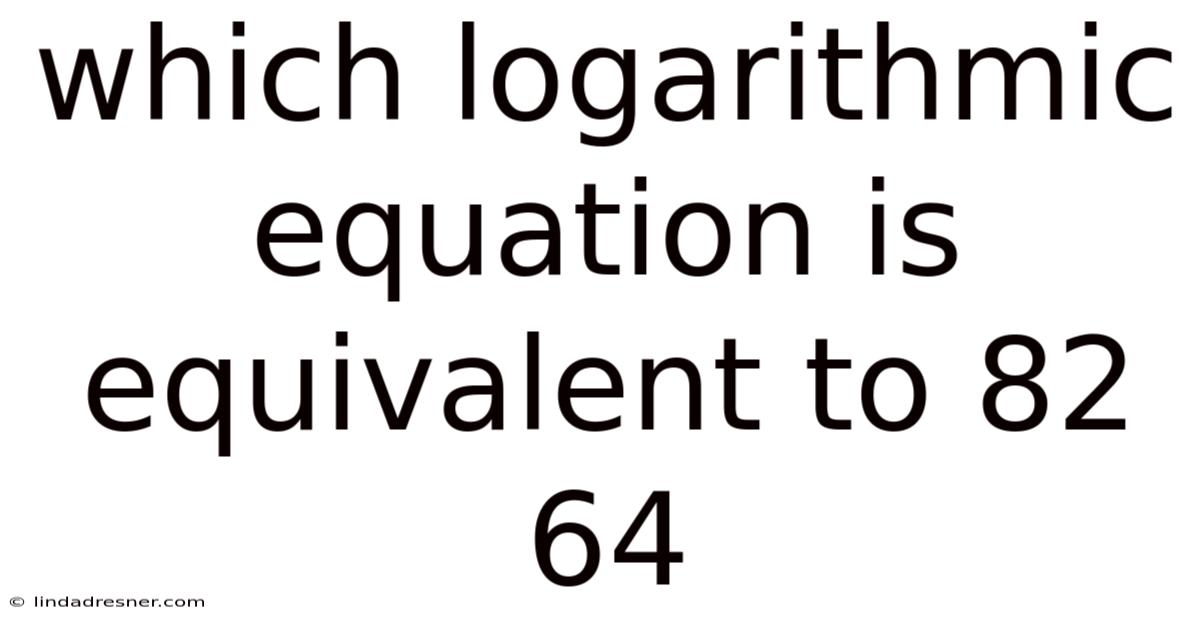
Converting Exponential Equations to Logarithmic Form: The Case of 8² = 64
The equation 8² = 64 is a straightforward exponential statement. In real terms, the equivalent logarithmic equation captures this same mathematical relationship but from a different perspective, asking a fundamental question: “To what exponent must we raise the base 8 to get the number 64? It tells us that when the number 8 is used as a factor twice (multiplied by itself), the result is 64. ” The direct logarithmic equivalent is log₈(64) = 2. This transformation is not merely a symbolic trick; it is the gateway to understanding the profound inverse relationship between exponentiation and logarithms, a cornerstone of advanced mathematics, science, and engineering.
The Core Relationship: Exponential vs. Logarithmic Form
At its heart, a logarithm answers the question: “What exponent produces a given number from a specific base?” This definition creates a perfect symmetry with exponential equations.
-
Exponential Form:
a^b = cais the base (the number being multiplied).bis the exponent (the number of times we multiply the base).cis the result or power.
-
Logarithmic Form:
log_a(c) = blog_adenotes “the logarithm to the basea.”cis the argument (the number we want to obtain).bis the exponent we are solving for.
These two forms are exactly equivalent. 4. Which means identify the exponent (b). 3. Identify the result/power (c).
On top of that, identify the base (a) from the exponential equation. On top of that, 2. Practically speaking, to convert from exponential to logarithmic form, you:
- Which means they are simply two sides of the same coin. Place them into the structure:
log_base(argument) = exponent.
Real talk — this step gets skipped all the time Nothing fancy..
Applying this to 8² = 64:
- Because of that, exponent (
b) = 2 - Result (
c) = 64 - Base (
a) = 8 - Logarithmic Form: log₈(64) = 2.
This reads as: “The logarithm of 64 with base 8 equals 2.” It confirms that raising 8 to the power of 2 yields 64.
A Step-by-Step Guide to Conversion
Mastering this conversion requires a consistent method. Let’s generalize and practice with several examples.
Step 1: Isolate the Exponential Expression.
Ensure your equation is in the clean form base^exponent = result. If it’s part of a larger equation, isolate that segment first But it adds up..
- Example:
5^x = 125is ready. - Example:
3^(y+1) = 27is ready; the exponent is the expression(y+1).
Step 2: Identify the Three Components.
- Base: The number being raised to a power. (In
8² = 64, base = 8). - Exponent: The power itself. (In
8² = 64, exponent = 2). - Result/Argument: The number on the other side of the equals sign. (In
8² = 64, result = 64).
Step 3: Rewrite in Logarithmic Form.
Use the template: log_(base)(result) = exponent That's the whole idea..
- For
8² = 64→log₈(64) = 2. - For
10^3 = 1000→log₁₀(1000) = 3. This is a common logarithm (base 10). - For
e^k = 7→log_e(7) = k. This is the natural logarithm, often written asln(7) = k. - For
2^(n-4) = 1→log₂(1) = n-4. (Remember, any non-zero base to the power of 0 is 1, son-4must equal 0).
Step 4: Verify Your Conversion.
A simple check is to take your logarithmic equation and “exponentiate” it back. Starting with log₈(64) = 2, rewrite it as 8^2 = 64. If this is true, your conversion is correct That alone is useful..
Scientific Explanation: Why This Inversion Matters
The power of logarithms lies in their ability to undo exponentiation, just as subtraction undoes addition and division undoes multiplication. This inverse property is critical for solving exponential equations where the exponent is the unknown variable.
Consider the equation 3^x = 50. Guessing the exponent is difficult. On the flip side, 5609). While log₃(50) isn’t a simple integer like 2 or 3, it is an exact real number (approximately 3.This is now a valid, precise expression for x. By converting to logarithmic form, we get x = log₃(50). Calculators and computers use this inverse relationship to compute logarithmic values.
This changes depending on context. Keep that in mind And that's really what it comes down to..
Historically, before the digital age, logarithms (developed by John Napier in the 17th century) were revolutionary because they transformed complex multiplication and division problems into simpler addition and subtraction problems. This was achieved through the fundamental law: log_a(M * N) = log_a(M) + log_a(N). For scientists and navigators dealing with large numbers, this was an monumental computational shortcut. On top of that, the equation 8² = 64 is trivial, but the principle scales to (8^2) * (8^5) = 8^(2+5) = 8^7 = 2,097,152. Using logs: log₈(2,097,152) = log₈(64) + log₈(32768) = 2 + 5 = 7.
Common Pitfalls and How to Avoid Them
When learning this conversion, several frequent errors occur:
