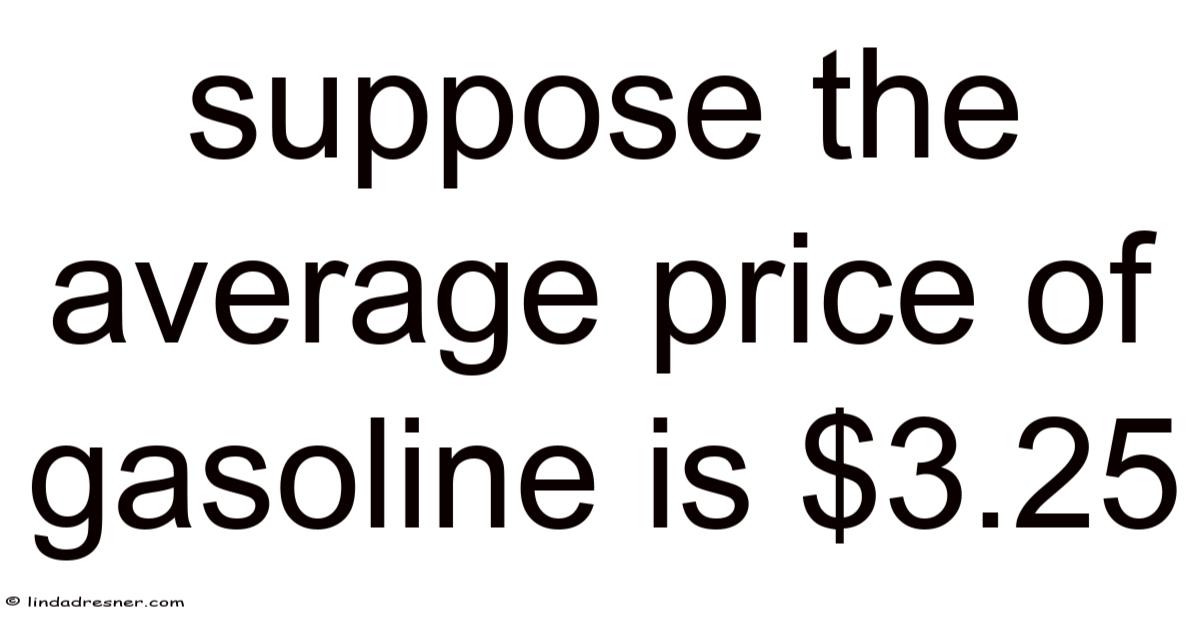
When economists and policymakers suppose the average price of gasoline is $3.In real terms, 25 per gallon, they are establishing a baseline scenario to model everything from household budgeting to national inflation trends. Which means s. But it is a price high enough to incentivize efficiency and alternative energy investment, yet low enough to prevent widespread demand destruction or political crisis. Which means understanding the ripple effects of this $3. That's why this specific price point—sitting comfortably between the historic lows of the early pandemic era and the painful peaks of 2022—represents a critical equilibrium zone for the U. economy. 25 benchmark requires dissecting the anatomy of the price itself, analyzing consumer behavior shifts, evaluating sector-specific impacts, and projecting long-term structural changes in the energy landscape.
The Anatomy of the $3.25 Price Tag
To understand what $3.25 at the pump actually signifies, one must look beneath the sticker price. The cost of a gallon of regular unleaded is essentially a composite of four distinct components: crude oil costs, refining margins, distribution and marketing expenses, and taxes.
At a $3.Still, this suggests a global supply-demand balance that is neither severely tight nor heavily oversupplied. 25 national average, crude oil typically accounts for roughly 50% to 55% of the cost, implying a West Texas Intermediate (WTI) or Brent crude price hovering in the low-to-mid $70s per barrel. OPEC+ production cuts might be in effect, but they are likely offset by solid non-OPEC growth (particularly from the U.S., Guyana, and Brazil) or sluggish demand growth from China and Europe Simple, but easy to overlook..
Refining costs and profits usually constitute 15% to 20% of the pump price. At $3.25, refinery utilization rates are likely healthy (above 90%), and crack spreads—the difference between crude input costs and refined product output prices—are moderate. This indicates no major unplanned outages (like hurricane damage on the Gulf Coast) and sufficient capacity to meet seasonal driving demand.
Distribution, marketing, and retail margins make up another 10% to 15%. This covers the pipeline transport, trucking to stations, and the convenience store markup. Finally, federal and state taxes average roughly $0.50 to $0.60 per gallon nationally, though this varies wildly—from roughly $0.30 in Alaska to over $0.80 in California and Pennsylvania.
That's why, a $3.25 average implies a "Goldilocks" crude market: geopolitical risk premiums are contained, global inventory draws are manageable, and the dollar index (DXY) is relatively stable, preventing imported inflation for dollar-denominated oil Easy to understand, harder to ignore. No workaround needed..
Household Economics: The Consumer Wallet Test
For the median American household, gasoline remains a relatively inelastic necessity. When the average price settles at $3.25, the immediate impact on disposable income is significant but manageable for most, though the distribution of that pain is highly unequal No workaround needed..
Consider a household driving 1,200 miles per month in a vehicle averaging 25 miles per gallon. That requires 48 gallons. On top of that, at $3. 25, the monthly fuel bill is $156. Practically speaking, compare this to $4. Even so, 50 (peak 2022), where the bill hits $216—a $60 monthly difference. Over a year, that $3.25 price saves this household $720 compared to the peak Not complicated — just consistent. Took long enough..
On the flip side, the marginal propensity to consume differs vastly by income quintile. For the bottom 20% of earners, transportation costs can eat up 15% to 20% of take-home pay. Now, at $3. 25, these households are forced into difficult trade-offs: deferring vehicle maintenance, reducing discretionary trips (impacting retail and leisure sectors), or cutting back on food quality. Conversely, for the top quintile, the $3.25 price is barely a rounding error in monthly cash flow.
Short version: it depends. Long version — keep reading.
This price point also influences vehicle purchasing decisions. That's why at $3. Here's the thing — 25, the total cost of ownership (TCO) calculation for Electric Vehicles (EVs) versus Internal Combustion Engine (ICE) vehicles remains a key battleground. While electricity per mile is significantly cheaper than $3.25 gasoline, the upfront price premium of EVs (even with tax credits) extends the payback period to 5–7 years for many models. So naturally, $3.25 gas acts as a moderate accelerant for EV adoption—strong enough to keep curiosity high, but weak enough to prevent a mass panic-switch that would strain the grid and critical mineral supply chains Simple, but easy to overlook..
Macroeconomic Transmission: Inflation and the Fed
The Federal Reserve watches gasoline prices with hawkish intensity, not just for the headline Consumer Price Index (CPI) print, but for core inflation expectations. Energy is volatile and stripped from core CPI, but gasoline prices are the most visible price signal in the economy. They shape the "inflation psychology" of consumers and small business owners Worth knowing..
If the average holds at $3.25 exerts a disinflationary drag, helping the Fed justify rate cuts or holds. If prices were $2.If prices were $3.On the flip side, 25, the year-over-year (YoY) contribution to headline CPI depends entirely on the base effect. In practice, 80 a year ago, $3. Still, 90 a year ago, $3. 25 adds inflationary pressure, potentially delaying monetary easing.
On top of that, $3.25 diesel (which usually trades at a premium to gasoline) dictates freight costs. In practice, the trucking industry moves over 70% of U. S. Because of that, freight tonnage. Practically speaking, a $3. 25 wholesale diesel rack price translates to a fuel surcharge that gets baked into the price of everything from Amazon packages to grocery store produce. If diesel stabilizes near this level, it removes a major variable cost from the supply chain, allowing retailers to stabilize shelf prices and improving the outlook for core goods inflation.
Counterintuitive, but true.
Sectoral Winners and Losers
No price exists in a vacuum; $3.25 creates distinct winners and losers across the corporate landscape.
Winners:
- Airlines: Jet fuel (kerosene) pricing correlates strongly with diesel/gasoline cracks. At this level, fuel costs represent roughly 20–25% of operating expenses (CASM), down from 30%+ at peak prices. This expands margins for legacy carriers like Delta and United, allowing for fleet renewal investments or shareholder returns.
- Chemicals & Plastics: U.S. petrochemical giants (Dow, LyondellBasell) use natural gas liquids (NGLs) as primary feedstock, giving them a structural advantage over European naphtha-based competitors. Still, lower gasoline prices often correlate with lower oil prices, which can compress the price of oil-derived feedstocks globally, benefiting integrated majors.
- Consumer Discretionary & Retail: Lower pump prices act as a stealth tax cut. Money not spent at the pump flows to restaurants, apparel, and home improvement. Historically, every 10-cent drop in gas adds roughly $10–12 billion annually to discretionary spending capacity.
Losers (or Challenged):
- Upstream E&P (Exploration & Production): For shale drillers in the Permian or Bakken, $3.25 retail implies WTI in the low $70s. While profitable, this is well below the "drill baby drill" incentive zone of $80+. Capital discipline remains the mantra; free cash flow goes to dividends/buybacks rather than aggressive growth drilling. This constrains future supply growth, planting the seeds for the next price spike.
- Refiners (Independent): Companies like Valero or PBF (without upstream integration) live or die by the *crack
