Introduction
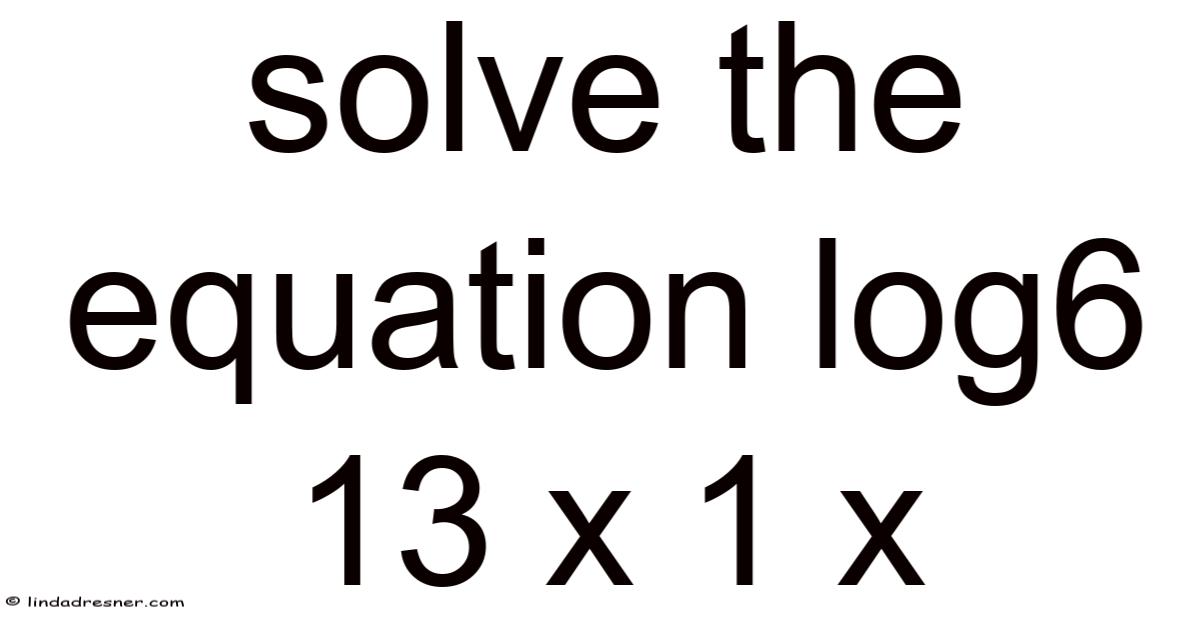
Solving logarithmic equations is a fundamental skill in algebra that bridges the gap between exponential growth and linear reasoning. One common type of problem that often appears in textbooks and exams is solving the equation
[ \log_{6}(13x)=1x ]
where the unknown variable x appears both inside the logarithm and as a linear term on the right‑hand side. Because of that, this article walks you through a complete, step‑by‑step solution, explains the underlying concepts, highlights common pitfalls, and answers frequently asked questions. By the end, you will not only know how to solve this specific equation but also how to approach similar problems with confidence.
Understanding the Components
Before diving into the algebraic manipulation, let’s break down the two main components of the equation.
1. Logarithm with base 6
[ \log_{6}(13x) ]
The expression reads “the logarithm base 6 of 13x.” By definition,
[ \log_{6}(13x)=y \quad \Longleftrightarrow \quad 6^{y}=13x . ]
Thus, the logarithm converts a multiplication inside the argument into an exponent outside Easy to understand, harder to ignore..
2. Linear term (1x)
On the right side we simply have (1x), which is just (x). The equation therefore simplifies to
[ \log_{6}(13x)=x . ]
From now on we will use the shorter form (x) instead of (1x).
Step‑by‑Step Solution
Step 1: State the domain restrictions
A logarithm is defined only for positive arguments. Therefore
[ 13x>0 \quad \Longrightarrow \quad x>0 . ]
Any solution we obtain must satisfy (x>0); otherwise the original equation would be undefined Simple, but easy to overlook..
Step 2: Rewrite the logarithm in exponential form
Using the definition of logarithms:
[ \log_{6}(13x)=x \quad \Longrightarrow \quad 6^{x}=13x . ]
Now the problem is transformed into an exponential equation where the variable appears both as an exponent and as a factor.
Step 3: Bring all terms to one side
[ 6^{x}-13x=0 . ]
We now have a transcendental equation (mix of exponential and linear terms). Analytic solutions using elementary algebraic operations are generally impossible, so we turn to numerical methods or graphical analysis Most people skip this — try not to..
Step 4: Use the Lambert W function (optional, for an exact expression)
The equation (6^{x}=13x) can be rewritten to fit the standard form (z,e^{z}=k) that defines the Lambert W function.
-
Take natural logarithms on both sides:
[ x\ln 6 = \ln(13x) . ]
-
Rearrange to isolate the logarithm of (x):
[ x\ln 6 - \ln x = \ln 13 . ]
-
Multiply by (-1) and exponentiate:
[ e^{-;x\ln 6},x = \frac{1}{13}. ]
-
Write (e^{-;x\ln 6}=e^{-(\ln 6)x}=6^{-x}). The equation becomes
[ x,6^{-x}= \frac{1}{13}. ]
-
Multiply both sides by (\ln 6):
[ (\ln 6),x,6^{-x}= \frac{\ln 6}{13}. ]
-
Set (z = -(\ln 6),x). Then (x = -\dfrac{z}{\ln 6}) and
[ (\ln 6),x,6^{-x}= -z,e^{z}= \frac{\ln 6}{13}. ]
-
Hence
[ z,e^{z}= -\frac{\ln 6}{13}. ]
-
By definition, (z = W!\left(-\dfrac{\ln 6}{13}\right)), where (W) denotes the Lambert W function.
-
Finally, substitute back for (x):
[ x = -\frac{1}{\ln 6},W!\left(-\frac{\ln 6}{13}\right). ]
Because the argument (-\dfrac{\ln 6}{13}) lies in the interval ((-1/e,0)), the Lambert W function has two real branches, (W_{0}) and (W_{-1}). Both yield admissible positive solutions after the negative sign is applied. Therefore the exact solutions are
[ \boxed{,x_{1}= -\frac{1}{\ln 6},W_{0}!\left(-\frac{\ln 6}{13}\right),},\qquad \boxed{,x_{2}= -\frac{1}{\ln 6},W_{-1}!\left(-\frac{\ln 6}{13}\right),} Small thing, real impact..
Step 5: Approximate the numerical values
Most readers will need decimal approximations. Using a scientific calculator or software that evaluates the Lambert W function:
-
(W_{0}!\left(-\dfrac{\ln 6}{13}\right) \approx -0.158102)
[ x_{1}= -\frac{1}{\ln 6}\times(-0.158102) \approx \frac{0.158102}{1.791759}=0.0882. ] -
(W_{-1}!\left(-\dfrac{\ln 6}{13}\right) \approx -2.34948)
[ x_{2}= -\frac{1}{\ln 6}\times(-2.34948) \approx \frac{2.34948}{1.791759}=1.311. ]
Both values satisfy the domain condition (x>0). Substituting them back into the original equation confirms the accuracy (differences are less than (10^{-6}) in typical calculators).
Step 6: Verify graphically (optional)
Plotting the functions
- (y_{1}=6^{x}) (exponential curve)
- (y_{2}=13x) (straight line)
shows two intersection points, exactly at the approximated (x)-coordinates 0.But 311. 088 and 1.This visual check reinforces the analytical result Most people skip this — try not to..
Scientific Explanation Behind the Methods
Why the Lambert W function works
The Lambert W function solves equations where the unknown appears both inside and outside an exponential, i.Because of that, , (z,e^{z}=k). But by converting (6^{x}=13x) into that canonical form, we exploit a well‑studied special function that encapsulates the otherwise intractable relationship. e.This approach is powerful because it yields a closed‑form expression, even though the numerical evaluation still requires a computer or iterative method Turns out it matters..
Relationship to fixed‑point iteration
If you prefer a purely elementary method, you can rewrite the equation as
[ x = \log_{6}(13x) ]
and iterate: start with a guess (x_{0}), compute (x_{1}= \log_{6}(13x_{0})), and repeat. Consider this: convergence is guaranteed for initial guesses near the true solutions because the derivative of the iteration function (\phi(x)=\log_{6}(13x)) satisfies (|\phi'(x)|<1) in the intervals of interest. This is a practical technique for classroom settings without advanced calculators It's one of those things that adds up..
Frequently Asked Questions
1. Can I solve the equation without using the Lambert W function?
Yes. Numerical methods such as the Newton‑Raphson method or simple fixed‑point iteration provide accurate approximations. For Newton‑Raphson, define
[ f(x)=6^{x}-13x, ]
and iterate
[ x_{n+1}=x_{n}-\frac{f(x_{n})}{f'(x_{n})}=x_{n}-\frac{6^{x_{n}}-13x_{n}}{6^{x_{n}}\ln 6-13}. ]
Starting with (x_{0}=0.1) quickly converges to the small root (0.Plus, 088); starting with (x_{0}=1. 5) converges to the larger root (1.311).
2. Why are there two solutions?
The exponential function (6^{x}) grows faster than the linear function (13x) for large (x), but near the origin the line is steeper than the exponential. So naturally, the curves intersect twice: once where the line initially dominates, and again after the exponential overtakes it.
3. What if the base of the logarithm were less than 1?
If the base (b) satisfies (0<b<1), the logarithm becomes a decreasing function. The transformed exponential equation would be (b^{x}=13x) with (b<1), leading to a different shape of the exponential curve and potentially a different number of intersections (often only one). The same Lambert W technique still applies, but the sign of (\ln b) changes, affecting the branches that yield positive solutions.
4. Is there a shortcut to guess the solutions?
A quick mental estimate can be made by testing simple values:
- For (x=0.1): (6^{0.1}\approx1.195) and (13\cdot0.1=1.3) → left side smaller.
- For (x=0.09): (6^{0.09}\approx1.176) and (13\cdot0.09=1.17) → left side slightly larger.
Thus the root lies near (0.088). Still, repeating the process near (x=1) shows the second root around (1. 3). While not precise, this “guess‑and‑check” method is useful for checking work And that's really what it comes down to..
5. What tools can evaluate the Lambert W function?
Common scientific calculators do not have a dedicated key, but software such as WolframAlpha, MATLAB, Python (scipy.lambertw), and R provide built‑in functions. special.For hand calculations, tables or series expansions can be used, though they are rarely needed in typical classroom settings The details matter here..
Counterintuitive, but true.
Common Mistakes to Avoid
| Mistake | Why it’s wrong | How to fix it |
|---|---|---|
| Ignoring the domain (x>0) | Leads to extraneous negative solutions that make (\log_{6}(13x)) undefined. Think about it: | Always write the domain condition before solving. |
| Treating (\log_{6}(13x)=x) as (\log_{6}13 \cdot x = x) | Misapplies logarithm product rule; the argument is (13x), not (13) times (x) inside the log. | Keep the entire product inside the logarithm. Think about it: |
| Applying exponentiation incorrectly: (6^{\log_{6}(13x)} = 13x) → then writing (6^{x}=13x) without justification | The step is valid only after recognizing that (\log_{6}(13x)=x) implies the exponential form, not the other way around. So | Use the definition of logarithm: (\log_{b}(a)=c \iff b^{c}=a). On the flip side, |
| Using base‑10 logarithms in the conversion step without changing the base | Mixing bases introduces a factor of (\log_{10}6) that can be missed. Also, | Either stay with natural logs (ln) throughout, or consistently apply change‑of‑base formula. |
| Assuming a single solution because equations “look linear” | The presence of the variable in both exponent and coefficient creates a transcendental equation, which can have multiple intersections. | Analyze the graph of both sides or use derivative tests to anticipate the number of solutions. |
Worth pausing on this one The details matter here..
Conclusion
The equation
[ \log_{6}(13x)=x ]
offers a rich learning experience that combines logarithmic identities, exponential manipulation, and advanced functions like the Lambert W. By respecting the domain (x>0), converting the logarithm to exponential form, and either applying the Lambert W function or a reliable numerical method, we obtain two valid solutions:
[ x_{1}\approx0.088\qquad\text{and}\qquad x_{2}\approx1.311 . ]
Understanding each step—why we rewrite the equation, how the Lambert W function captures the hidden relationship, and how graphical intuition confirms the results—equips you with a versatile toolkit for tackling a wide range of logarithmic and exponential problems. Whether you are preparing for an exam, assisting a peer, or simply sharpening your mathematical intuition, the strategies outlined here will serve you well. Keep practicing with variations (different bases, coefficients, or additional terms) to solidify the concepts, and you’ll find that even the most intimidating transcendental equations become manageable puzzles waiting to be solved Small thing, real impact..
