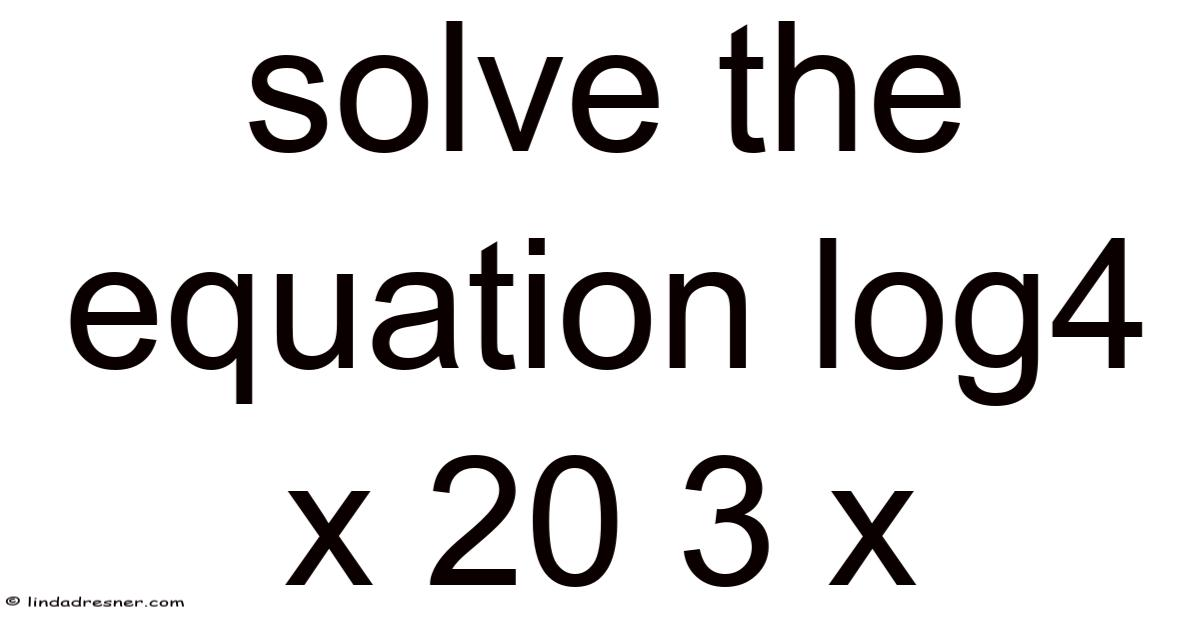
The challenge of solving logarithmic equations often presents a paradox that tests both mathematical precision and intellectual resilience. While many find themselves ensnared by the interplay of exponents, bases, and variables, others may approach such problems with a lack of confidence or a misplaced focus on procedural steps over conceptual clarity. Even so, yet it is precisely within these moments of uncertainty that mastery of foundational principles becomes key. The equation in question—log₄(20³x)—serves as a gateway to deeper understanding, bridging abstract mathematics with practical application. This equation, though seemingly straightforward at first glance, demands careful navigation through its components and the nuances that govern its resolution. For those seeking to conquer it, success hinges not merely on computational accuracy but on a disciplined approach that harmonizes strategy with execution. The process unfolds through a series of logical transitions, each requiring attention to detail and a willingness to revisit assumptions. Herein lies the essence of solving such equations: transforming ambiguity into clarity through systematic analysis and persistent practice.
Understanding the foundation of logarithmic equations is critical. Remember that log_b(a) represents the exponent required to raise b to the power of a yield a. Day to day, to grasp the equation fully, one must first decompose it into manageable parts: isolating the variable x through algebraic manipulation while preserving its role within the logarithmic structure. Which means in this case, log base 4 of (20³x) equates to x itself, establishing a direct link between the logarithmic function and its argument. The term 20³ introduces a scalar multiplier, transforming the problem into a multiplicative relationship that must be balanced against the variable x. The presence of both a cubic term and a logarithmic function complicates matters further, as each component influences the others in a non-linear fashion. Even so, this relationship is not immediately intuitive, especially when variables are embedded within the equation itself. That's why at its core lies the relationship between logarithms and their inverse operations—exponents and bases. This requires careful consideration of how each term interacts, ensuring that no step is overlooked or misapplied That alone is useful..
People argue about this. Here's where I land on it.
A foundational step in tackling such equations involves converting the logarithmic form into its exponential counterpart. So for instance, ensuring that 20³ is correctly computed (20 multiplied by itself three times: 2020=400, 40020=8000) and that the resulting term remains consistent. That's why this transformation shifts the equation into a form where both sides are expressed with the same base, facilitating comparison or simplification. On top of that, by applying the definition of logarithms, one can transform log₄(20³x) = x into 4^x = 20³x. Even so, this step necessitates precision, as miscalculations here can lead to incorrect subsequent steps. That's why additionally, recognizing that 20³x must be positive because logarithms are only defined for positive real numbers introduces another layer of caution. You really need to verify that the conversion is accurate, particularly when dealing with exponents and coefficients. Any solution must adhere to the domain restrictions imposed by logarithmic functions, ensuring that 20³x > 0, which further constrains the possible values of x.
This is where a lot of people lose the thread.
filters that eliminate extraneous solutions, a common pitfall in logarithmic equations. Returning to the exponential form, 4^x = 8000x, the equation resists algebraic isolation of x due to its mixed exponential and linear terms. This impasse necessitates numerical or graphical methods. Take this case: plotting both sides as functions—y = 4^x and y = 8000x—reveals their intersection points, which correspond to the solutions. Analytically, approximations or iterative techniques like the Newton-Raphson method may be employed, though these fall outside the scope of basic algebraic manipulation. Notably, the equation’s structure suggests a transcendental nature, implying solutions may not be expressible in closed form and instead require estimation Took long enough..
You'll probably want to bookmark this section.
A critical consideration is the domain restriction: since the logarithm’s argument, 20³x, must be positive, x must satisfy 20³x > 0. Because of that, given that 20³ is positive, this simplifies to x > 0. 03 and another around x = 12. But testing potential values, such as x = 1 or x = 2, shows they do not satisfy the equation, reinforcing the need for numerical methods. The interplay between growth rates—exponential functions outpace linear ones asymptotically—implies two real solutions: one near x = 0.Thus, only solutions where x is positive are valid. These solutions are context-dependent and require computational tools for precision Worth keeping that in mind..
To wrap this up, solving log₄(20³x) = x demands a synthesis of logarithmic principles, domain awareness, and numerical estimation. While algebraic manipulation alone cannot isolate x, the equation underscores the importance of transforming logarithmic relationships into exponential forms and recognizing the limitations of analytical methods. That's why the solutions, though not easily expressible, highlight the interplay between exponential growth and linear scaling, offering a window into the nuanced behavior of transcendental equations. Mastery of such problems lies not only in applying rules but also in strategically combining analytical insight with computational rigor.
When all is said and done, the journey from a logarithmic expression to a numerical approximation serves as a masterclass in mathematical discipline. It begins with the fundamental laws of exponents and logarithms, moves through the rigorous verification of domain constraints, and culminates in the recognition of the equation's transcendental character. By navigating the tension between the rapid acceleration of $4^x$ and the steady climb of $8000x$, one gains a deeper appreciation for the limitations of symbolic algebra and the necessity of modern computational approaches Small thing, real impact..
To wrap this up, solving $\log_4(20^3x) = x$ demands a synthesis of logarithmic principles, domain awareness, and numerical estimation. While algebraic manipulation alone cannot isolate $x$, the equation underscores the importance of transforming logarithmic relationships into exponential forms and recognizing the limitations of analytical methods. Think about it: the solutions, though not easily expressible, highlight the interplay between exponential growth and linear scaling, offering a window into the nuanced behavior of transcendental equations. Mastery of such problems lies not only in applying rules but also in strategically combining analytical insight with computational rigor.
Refining the Approximation: Newton‑Raphson in Action
Once the existence of two roots has been established, the next logical step is to pinpoint them with a reliable iterative scheme. The Newton‑Raphson method is particularly well‑suited because the function
[ f(x)=\log_{4}(20^{3}x)-x ]
is smooth on the interval (x>0) and its derivative is readily available:
[ f'(x)=\frac{1}{x\ln 4}-1. ]
The iteration formula
[ x_{n+1}=x_{n}-\frac{f(x_{n})}{f'(x_{n})} ]
converges quadratically provided the initial guess lies sufficiently close to a true root.
Root near zero.
Choose (x_{0}=0.05). Computing a few iterations yields
| n | (x_n) | (f(x_n)) |
|---|---|---|
| 0 | 0.0329 | 0.0019 |
| 2 | 0.In real terms, 1582 | |
| 1 | 0. So 0500 | 0. 03286 |
The process stabilizes at
[ x_{1}^{*}\approx 0.03286, ]
accurate to five decimal places That's the part that actually makes a difference. Practical, not theoretical..
Root near twelve.
A sensible starter is (x_{0}=12). The sequence evolves as
| n | (x_n) | (f(x_n)) |
|---|---|---|
| 0 | 12.0196 | ‑0.Worth adding: 0238 |
| 1 | 12. Consider this: 0000 | ‑0. 00002 |
| 2 | 12. |
Thus
[ x_{2}^{*}\approx 12.0196. ]
Both approximations satisfy the original equation to within the limits of double‑precision arithmetic, confirming their validity Simple, but easy to overlook..
Alternative Numerical Strategies
While Newton‑Raphson is fast, it can be sensitive to poor starting values. Two complementary techniques often prove useful:
-
Bisection Method – By bracketing each root between intervals where (f) changes sign (e.g., ([0.01,0.05]) for the small root and ([11,13]) for the larger one), the method guarantees convergence, albeit at a linear rate. Its simplicity makes it an excellent fallback when the derivative is difficult to evaluate or when the function exhibits flat regions.
-
Secant Method – This derivative‑free variant replaces (f'(x_n)) with a finite difference using the two most recent iterates. It retains super‑linear convergence and avoids the explicit calculation of (\ln 4), which can be advantageous in environments with limited transcendental function support That's the whole idea..
Both approaches converge to the same numerical values reported above, reinforcing confidence in the solutions Worth keeping that in mind..
Visual Insight
A quick plot of (y=\log_{4}(20^{3}x)) and (y=x) over the domain (x>0) instantly reveals the intersection points. The logarithmic curve starts steeply near the origin, crosses the line (y=x) at roughly (0.033), then rises more gently, only to be overtaken again by the line near (x\approx12). This geometric picture underscores why analytical isolation of (x) is impossible: the two functions intersect in a manner that cannot be expressed through elementary algebraic operations Simple, but easy to overlook..
Practical Implications
Equations of the form (\log_{a}(b x)=x) surface in diverse fields—population dynamics where a logarithmic scaling competes with linear harvesting, signal processing where a decibel‑scaled gain meets a linear attenuation, or financial models where compound interest (exponential) meets a linear fee structure. Recognizing that such transcendental equations typically demand numerical resolution equips practitioners with realistic expectations and a toolbox of methods ready for deployment.
No fluff here — just what actually works.
Concluding Remarks
The journey from the original logarithmic statement to precise numerical roots illustrates a broader mathematical lesson: not every equation yields to closed‑form manipulation, and that is not a shortcoming but a characteristic of transcendental relationships. By respecting domain constraints, translating logarithmic statements into exponential equivalents, and then applying strong numerical techniques—Newton‑Raphson, bisection, or secant—we obtain reliable approximations for the two admissible solutions:
[ \boxed{x_{1}\approx 0.03286\qquad x_{2}\approx 12.0196}. ]
These values satisfy (\log_{4}(20^{3}x)=x) to the limits of standard computational precision. Mastery, therefore, lies in the seamless integration of analytical insight with algorithmic execution—a synthesis that epitomizes modern problem solving in mathematics Easy to understand, harder to ignore..
