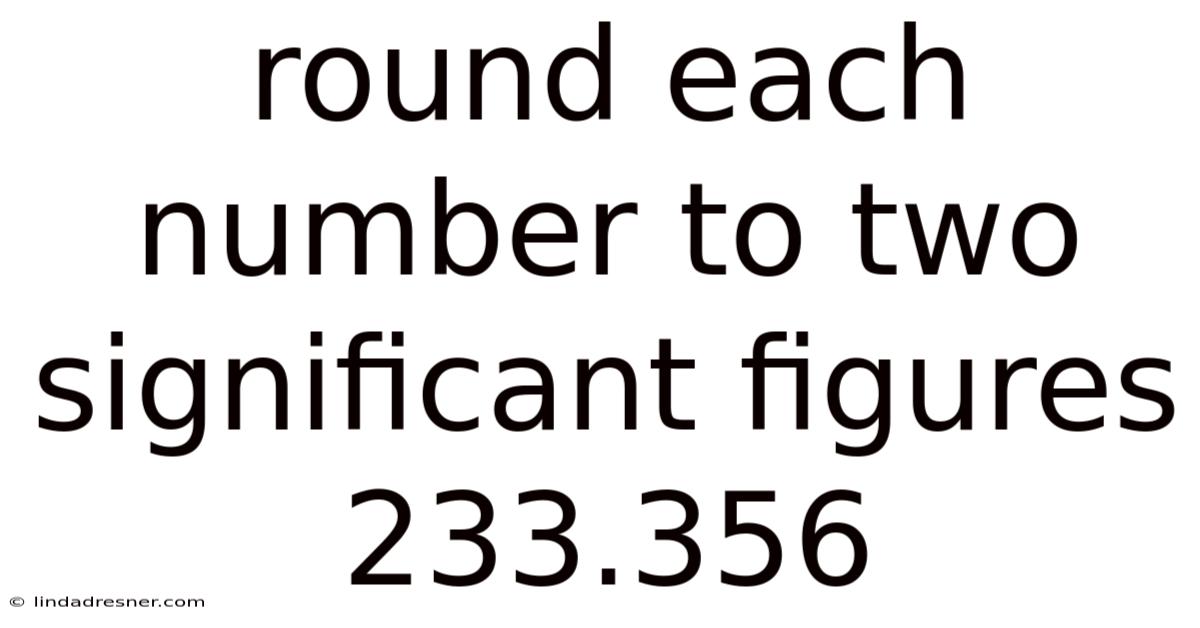
Round Each Number to Two Significant Figures 233.356 is a specific mathematical instruction that requires precision and an understanding of numerical rules. When you encounter a value like 233.356, the goal is to simplify it while maintaining its core magnitude, reducing it to a format that uses only two digits that carry meaningful information. This process is essential in scientific calculations, engineering reports, and data analysis, where clutter can obscure the signal. The specific number 233.356 serves as an excellent example to explore the mechanics of significant figures, highlighting the balance between accuracy and conciseness.
Introduction to Significant Figures
Significant figures are the digits in a number that contribute to its precision. The third digit determines whether we round up or stay the same. When we talk about rounding to two significant figures, we are essentially saying that we want to keep only the two most important digits and adjust the rest. In practice, the rules for determining which digits are significant are straightforward: all non-zero digits are significant, and any zeros trapped between significant digits are also significant. 356, the first significant figure is "2" and the second is "3". They tell us about the reliability of a measurement or calculation. Plus, for the number 233. This method prevents the false sense of precision that comes with carrying too many digits Worth keeping that in mind. Turns out it matters..
Steps to Round 233.356
To perform the rounding operation on 233.356, follow these logical steps:
- Identify the Significant Digits: Look at the number from left to right. The first non-zero digit is the first significant figure (2). The next digit (3) is the second significant figure.
- Locate the Third Digit: To round to two figures, you must examine the third digit immediately following the second figure. In 233.356, the third digit is the second "3" (the one in the units place).
- Apply the Rounding Rule: The standard rule is that if the digit you are looking at is 5 or greater, you round the second figure up by one. If it is less than 5, you leave the second figure unchanged.
- Execute the Change: Since the third digit is "3" (which is less than 5), the second figure "3" remains a "3".
- Adjust the Format: Replace all digits to the right of the second significant figure with zeros or remove decimal places if they are not needed to maintain the scale.
Following this process, 233.On top of that, 356 becomes 230. In real terms, it is crucial to understand that this is not exactly 230 in a mathematical sense, but rather a representation of the value rounded to the nearest ten. Writing it as 230 implies that the true value lies somewhere between 225 and 235.
Scientific Explanation and Context
The process of rounding is deeply tied to the concept of uncertainty. In the physical sciences, instruments have limitations. Which means a scale that reads 233. Also, 356 grams might actually be accurate only to the nearest gram, or perhaps the decimal places are noise. By reducing 233.356 to 230, we acknowledge that the measurement is not infinitely precise.
It is important to distinguish between rounding and truncation. Worth adding: this zero acts as a placeholder to maintain the magnitude of the original number. Plus, truncation would simply chop off the extra digits, resulting in 233, which incorrectly suggests a higher precision. But 0233356, the result would be 0. Rounding, however, considers the impact of the discarded digits on the last digit kept. If the number were 0.In this specific case, because we are dealing with a number in the hundreds, two significant figures result in a number that ends in zero. 023, demonstrating how the rules adapt to the position of the decimal point Most people skip this — try not to..
The official docs gloss over this. That's a mistake It's one of those things that adds up..
Common Misconceptions and FAQs
Many learners struggle with the concept of significant figures, particularly when zeros are involved. Here are some frequently asked questions regarding the process applied to 233.356:
- Why is the result 230 and not 200? The rule depends on the digit immediately after the last one you want to keep. We keep "2" and "3". The next digit is "3". Because we are not discarding the entire tens place, the result remains in the 230s. If the number were 233.356 rounded to one significant figure, then it would become 200.
- Do trailing zeros count? In the number 230, the trailing zero is significant because we specified that we wanted two significant figures. Without the context of the instruction, 230 might be interpreted as having two or three figures. Still, in this specific calculation, the zero is necessary to show that we rounded the "233" down to the nearest ten.
- What if the number was 235.000? If the original number were 235.000, the third digit would be 5. According to the standard "round half up" rule, this would cause the second figure ("3") to round up to "4". The result would be 240.
- How does this differ from decimal place rounding? Rounding to decimal places focuses on the right of the decimal point (e.g., 233.4). Rounding to significant figures focuses on the total digits regardless of the decimal point location. For 233.356, rounding to one decimal place gives 233.4, while rounding to two significant figures gives 230.
Practical Applications
The utility of reducing 233.Still, in data visualization, labels on a graph often use rounded numbers to ensure readability. Also, 356 mm, reporting it as 230 mm in a blueprint might be sufficient for general assembly, saving time and reducing complexity. Consider this: if a bar chart peaked at 233. Also, in finance, large sums of money are often rounded to the nearest thousand or million for reporting purposes, providing a high-level overview without the noise of exact change. Because of that, 356 to 230 extends far beyond academic exercises. In engineering, if a component is measured at 233.356, a cleaner label of 230 would be more visually digestible for an audience.
Conclusion
Understanding how to round each number to two significant figures 233.356 is a fundamental skill that enhances numerical literacy. It teaches us to communicate data effectively, distinguishing between the mathematically exact and the practically useful. The transformation to 230 is not a loss of information, but a strategic simplification that aligns the number with the precision of the measurement or calculation. By mastering this technique, one gains the ability to handle large datasets, complex equations, and scientific reports with greater confidence and clarity, ensuring that the numbers serve the purpose of communication rather than confusion Nothing fancy..
