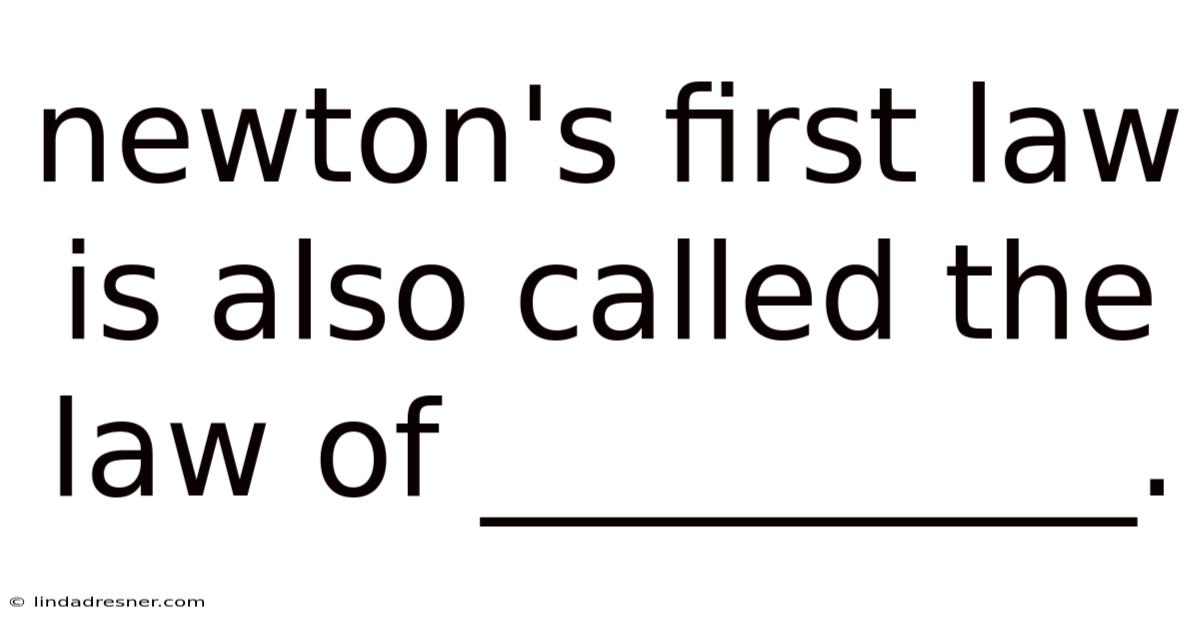
Understanding Newton's First Law is essential for anyone exploring the foundations of physics and motion. On the flip side, this principle, often referred to as the law of inertia, is a cornerstone in the study of movement and forces. By grasping this concept, students and learners can better appreciate how objects behave in the absence of external influences. In this article, we will dig into the significance of Newton's First Law, its historical context, and how it shapes our understanding of the natural world But it adds up..
The law of inertia is a fundamental idea in classical mechanics, introduced by Sir Isaac Newton in his interesting work Philosophiæ Naturalis Principia Mathematica. This law states that an object will remain at rest or in uniform motion in a straight line unless acted upon by an external force. In simpler terms, it means that objects tend to stay in their current state of motion. This principle not only explains everyday phenomena but also serves as the basis for more advanced scientific theories Surprisingly effective..
To fully grasp the importance of Newton's First Law, it’s crucial to understand the concept of inertia. On top of that, inertia is the resistance of any physical object to changes in its state of motion. The more massive an object is, the greater its inertia. What this tells us is a heavy book will not move easily if you try to push it, while a lighter object will respond more readily. The law of inertia highlights this resistance, emphasizing that motion requires a force to initiate it That's the whole idea..
When we examine the historical background of this law, we find it rooted in the observations of ancient philosophers. On the flip side, it was Newton who formalized these ideas into a mathematical framework. In practice, his work revolutionized the way scientists approached the study of motion, providing a clear structure to understand the forces at play. Today, this principle remains relevant in various fields, from engineering to space exploration.
And yeah — that's actually more nuanced than it sounds.
One of the most compelling aspects of Newton's First Law is its ability to explain why we don’t feel pushed forward when a car accelerates. But while the car moves, our bodies tend to stay in place due to inertia. This phenomenon is often referred to as the sensation of weightlessness during sudden movements. Understanding this connection helps us appreciate the invisible forces that govern our daily lives Most people skip this — try not to..
Now, let’s break down the key components of Newton's First Law. In real terms, whether it’s a small pebble or a massive asteroid, the principle remains the same. So naturally, for instance, when you throw a ball, it continues moving until a force—like gravity or air resistance—acts upon it. This universality underscores the consistency of natural laws across different scales. Plus, the law applies to all objects, regardless of their size or composition. Which means when we observe objects in motion, we can see how they adhere to this fundamental rule. The law of inertia reminds us that motion requires an intervention.
To illustrate this concept, consider the example of a car. When it accelerates, the passengers inside feel pushed forward. This happens because the car’s engine exerts a force on the passengers, overcoming their inertia. Without this force, they would remain in their original state of rest or uniform motion. Now, similarly, when a ball is dropped, it falls to the ground due to gravity, but until that force acts, it remains suspended in the air. These examples highlight how the law of inertia governs everyday experiences Worth keeping that in mind. Still holds up..
Another important point is the distinction between inertia and acceleration. On top of that, this distinction is crucial for students studying kinematics and dynamics. While inertia describes the tendency of objects to resist changes in motion, acceleration refers to the rate at which that motion changes. Because of that, newton’s First Law emphasizes that without an external force, an object will maintain its state of motion. It helps them understand how forces influence movement and how objects respond to them.
In educational settings, teaching Newton's First Law effectively requires a clear approach. Students often struggle with abstract concepts, but using relatable examples can make the learning process more engaging. Here's a good example: demonstrating how a toy car behaves when pushed can help students visualize the principle. Additionally, incorporating interactive activities, such as experiments with different masses, reinforces the idea that heavier objects require more force to change their motion.
Some disagree here. Fair enough Easy to understand, harder to ignore..
The relevance of Newton's First Law extends beyond the classroom. In the realm of space exploration, this principle is vital for understanding how spacecraft move through the vacuum of space. Even so, since there is no air resistance in space, the inertia of objects becomes even more pronounced. Astronauts and equipment must be carefully managed to account for this behavior, ensuring safe and efficient operations.
On top of that, this law plays a significant role in engineering design. Engineers rely on the understanding of inertia to create systems that can withstand or respond to motion. Take this: in designing vehicles, the concept of inertia helps in optimizing fuel efficiency and stability. By minimizing unnecessary forces, engineers can enhance the performance of machines and structures.
When exploring the implications of Newton's First Law, it’s important to consider its limitations. Here's the thing — while the principle is widely accepted, it does not account for all aspects of motion, especially in complex systems involving friction or non-ideal conditions. On the flip side, its simplicity and accuracy make it a reliable foundation for further study. As learners progress, they can build upon this knowledge to explore more advanced topics in physics Small thing, real impact..
All in all, Newton's First Law is not just a theoretical concept but a practical tool that shapes our understanding of the universe. Now, by recognizing the importance of inertia, we gain insight into the forces that govern our world. Which means whether we are observing a falling apple or navigating a spacecraft, this law remains a guiding principle. Embracing this knowledge empowers us to think critically and apply scientific concepts to real-life situations.
Understanding the law of inertia is a vital step in mastering the basics of physics. It encourages curiosity and deepens our appreciation for the natural laws that shape our reality. Think about it: as we continue to explore the wonders of motion, let this article serve as a reminder of the power of scientific thinking. By staying informed and engaged, we can open up the secrets of the universe one concept at a time.
The interplay between theory and practice remains a cornerstone of scientific advancement. Such principles intertwine with innovation, fostering progress across disciplines. Because of that, their enduring relevance underscores the universal applicability of scientific principles, reminding us of our shared connection to the cosmos and everyday life. This enduring truth continues to shape our understanding and drive advancement.
It sounds simple, but the gap is usually here.
The law's influence extends even further, impacting fields like sports. Practically speaking, a baseball player’s swing relies heavily on inertia – the force needed to overcome the ball's resistance to changes in motion. Similarly, a basketball player’s jump and subsequent landing are governed by inertia, influencing their trajectory and control. Athletes intuitively understand and manipulate inertia to achieve optimal performance Worth knowing..
Beyond specific disciplines, the concept of inertia also informs our understanding of planetary motion. This principle is fundamental to understanding orbits, gravitational forces, and the overall dynamics of our solar system. The vast distances involved and the immense masses of celestial bodies mean that once a planet is set in motion, it tends to continue moving in a straight line at a constant velocity unless acted upon by an external force. Without accounting for inertia, predicting the paths of spacecraft and celestial bodies would be impossible.
To build on this, the practical applications of understanding inertia are woven into everyday life. Practically speaking, consider simply stopping a moving car – the force felt is a direct consequence of overcoming the inertia of the vehicle and its occupants. Seatbelts and airbags are designed to counteract this inertia, minimizing the risk of injury during sudden stops. Even something as seemingly simple as carrying a heavy object requires an understanding of inertia to avoid strain or injury Practical, not theoretical..
When all is said and done, Newton's First Law provides a foundational framework for comprehending the world around us. Even so, this resistance, this inertia, is not merely a passive property; it’s a fundamental aspect of how the universe operates. By understanding and applying this principle, we not only gain a deeper appreciation for the laws of physics but also develop a more nuanced understanding of the forces that shape our daily experiences and the grand scale of cosmic events. In real terms, it’s a cornerstone of physics, demonstrating that objects resist changes in their state of motion. It's a principle that remains remarkably relevant, continuing to inspire scientific inquiry and drive technological innovation And it works..
Some disagree here. Fair enough.
So, to summarize, Newton's First Law is far more than a simple statement; it's a profound insight into the nature of motion and the forces that govern the universe. Because of that, from the smallest object to the largest celestial body, inertia is key here in shaping our reality. By understanding this fundamental principle, we get to a deeper appreciation for the elegance and power of scientific thought. It's a concept that continues to inspire exploration, innovation, and a more profound understanding of our place in the cosmos Easy to understand, harder to ignore..
