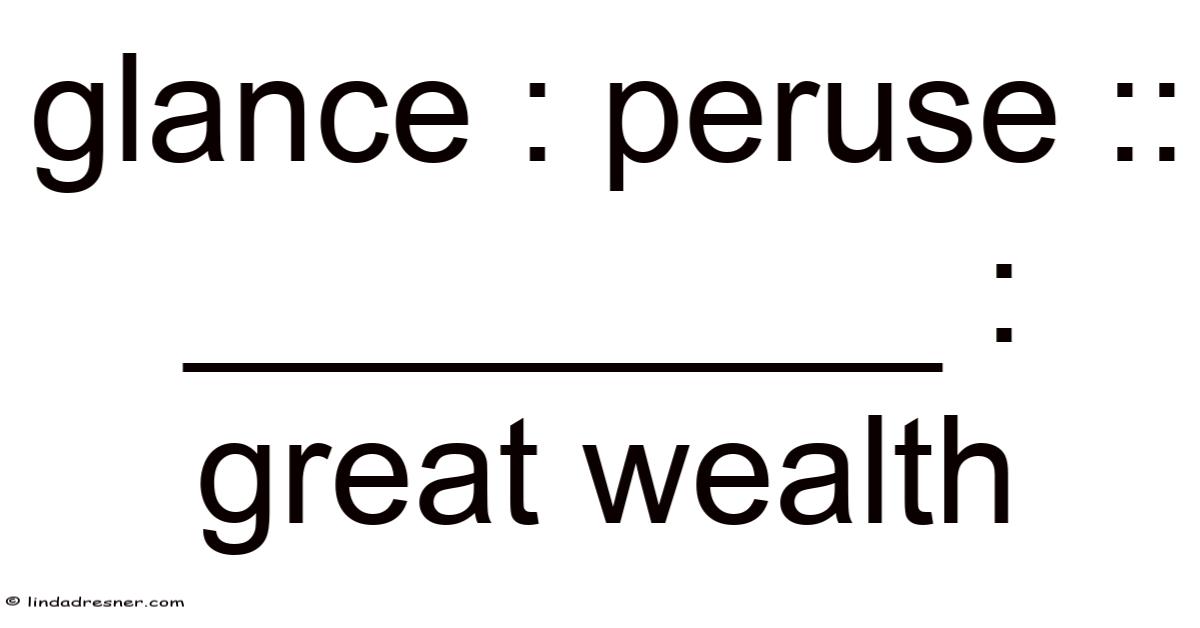
Glance : Peruse :: Skim : Amass
The phrase “glance : peruse :: skim : amass” is a classic example of a word‑pair analogy that juxtaposes two levels of engagement—quick versus thorough—across two distinct domains: reading and wealth accumulation. In this article, we’ll unpack the meaning of each term, explore how the analogy operates, and illustrate the concept with practical examples and useful applications. By the end, you’ll have a clear understanding of how to use this analogy to sharpen your analytical skills, whether you’re tackling academic texts, business reports, or financial planning.
Real talk — this step gets skipped all the time.
Introduction
Analogies are powerful tools for learning because they reveal relationships between seemingly unrelated concepts. They help us see patterns, make predictions, and communicate complex ideas simply. The analogy glance : peruse :: skim : amass invites us to compare two pairs of actions that differ in depth and intent. The first pair—glance and peruse—concerns reading. The second pair—skim and amass—concerns wealth. By examining how the first pair relates, we can infer the relationship between the second pair Practical, not theoretical..
Understanding the First Pair: Glance vs. Peruse
Glance
- Definition: A quick, superficial look at something.
- Connotation: Brief, cursory, often without intent to understand deeply.
- Usage Example: She glanced at the email before heading to the meeting.
Peruse
- Definition: To read or examine something carefully and thoroughly.
- Connotation: Detailed, patient, often with the goal of comprehension or analysis.
- Usage Example: He perused the contract line by line, noting every clause.
The Relationship
- Depth of Engagement: Glance is shallow; peruse is deep.
- Time Investment: Glance takes seconds; peruse can take minutes or hours.
- Purpose: Glance for a quick overview; peruse for full understanding.
Applying the Relationship to the Second Pair
Skim
- Definition: To read something quickly, focusing on main ideas while skipping details.
- Connotation: Efficient, surface‑level, often used as a pre‑reading strategy.
- Usage Example: She skimmed the article to decide whether it was relevant.
Amass
- Definition: To gather or accumulate a large amount of something, typically over time.
- Connotation: Gradual, deliberate, involving effort and strategy.
- Usage Example: He amasses wealth through diversified investments.
The Analogy in Action
- Skim is to Amass what Glance is to Peruse.
- Both pairs compare a quick, superficial action to a thorough, deliberate one.
- The analogy suggests that just as a glance is a brief way to get a sense of a text, a skim is a brief way to get a sense of a financial situation, but only amassing truly builds wealth.
Why This Analogy Matters
1. Enhancing Reading Strategies
- Academic Success: Knowing when to glance, skim, or peruse can save time and improve comprehension.
- Professional Efficiency: Executives often skim reports to capture key points before deep dives.
2. Financial Literacy
- Investment Decisions: Skimming financial statements can flag red‑flags, but amassing wealth requires detailed analysis (perusing balance sheets, cash flows, etc.).
- Risk Management: Quick scans might miss nuanced risks; thorough reviews prevent costly mistakes.
3. Cognitive Load Management
- Avoiding Burnout: Alternating between quick scans and deep dives keeps mental fatigue in check.
- Prioritization: Recognize what needs a glance vs. what requires perusal (or skim vs. amass).
Practical Applications
A. Academic Writing
- First Pass: Glance the syllabus to understand expectations.
- Second Pass: Skim the textbook chapters.
- Third Pass: Peruse the research articles.
- Final Step: Amass insights to craft a compelling essay.
B. Business Analysis
- Initial Review: Glance at the executive summary of a proposal.
- Broad Assessment: Skim the market research.
- Detailed Examination: Peruse the financial projections.
- Strategic Planning: Amass a portfolio of actionable strategies.
C. Personal Finance
- Quick Check: Glance at monthly bank statements.
- Overview: Skim the investment portfolio.
- In‑Depth Review: Peruse the terms of each investment.
- Growth: Amass wealth through disciplined saving and investing.
Frequently Asked Questions (FAQ)
| Question | Answer |
|---|---|
| Can I use skim instead of glance in the analogy? | Skim is a more active, reading‑specific term, while glance is broader. The analogy works best with glance because it captures the idea of a very brief, almost accidental look. |
| Is amass the only correct word for the second pair? | Amass is the most fitting because it conveys deliberate accumulation, mirroring how peruse implies deliberate, detailed examination. Alternatives like accumulate or collect could also fit but are less idiomatic. |
| How can I test my understanding of this analogy? | Try creating your own analogies using the same structure: quick action : thorough action :: quick action : thorough action in a different domain (e.g., scan : investigate :: scan : investigate). |
| **Does the analogy imply that skimming is as valuable as amassing?But ** | No. Practically speaking, the analogy highlights the relationship, not the value. Skimming is a tool, while amassing is the end goal. Plus, |
| **Can this analogy be adapted for digital media? ** | Absolutely. Glance at a headline, skim the article, peruse the comments, and amass knowledge or influence online. |
Conclusion
The analogy glance : peruse :: skim : amass elegantly illustrates how a quick, superficial approach contrasts with a deep, intentional one across two fields: reading and wealth building. When should I skim? When must I peruse? By mastering the balance between quick scans and thorough examinations, you can work through information overload, make smarter financial decisions, and ultimately “amass” the insights or wealth you seek. And when is it time to amass? Even so, use this framework as a mental checklist: *When should I glance? * Mastering these distinctions will sharpen your analytical skills, boost productivity, and empower you to thrive in both academic and financial arenas Nothing fancy..
###Applying the Analogy in Practice
1. Information Overload in the Digital Age
In today’s hyper‑connected environment, the habit of glancing at headlines or social‑media snippets can quickly become a habit of skim‑reading entire articles. While this rapid intake keeps you informed, it often sacrifices depth. By deliberately shifting to perusing — reading with intent to understand nuance, context, and underlying arguments — you transform a fleeting impression into actionable insight. The same principle applies to data dashboards: a quick glance may reveal a trend, but a thorough perusal of the underlying metrics uncovers the story behind the numbers Small thing, real impact. And it works..
2. Financial Decision‑Making
When evaluating a new investment opportunity, a glance at the headline return rate can be misleading. A more disciplined approach — skimming the prospectus for high‑level figures, then perusing the detailed risk disclosures — ensures that the decision to amass wealth is based on comprehensive analysis rather than surface‑level allure. This layered review mirrors the reading process: each step builds a richer understanding that supports a more solid accumulation of assets.
3. Personal Productivity
Adopting a “glance‑to‑peruse” rhythm can dramatically improve productivity. Start a work session by glancing at your task list to prioritize. Move to skimming relevant documents for key points, then transition to perusing the sections that matter most for deep work. The final stage — amassing knowledge or completed tasks — delivers tangible results, reinforcing the habit loop.
Key Takeaways
- Glance offers a rapid, superficial snapshot; it is useful for triage but not for mastery.
- Skim adds a purposeful, reading‑focused layer that extracts more than a glance alone.
- Peruse demands deliberate, detailed engagement, turning information into insight.
- Amass represents the strategic accumulation of wealth, knowledge, or outcomes that follows thorough examination.
By consciously moving through these stages, you align your actions with the depth required for meaningful progress, whether you are navigating a dense report or building a diversified portfolio.
Conclusion
The glance : peruse :: skim : amass analogy serves as a concise mental framework that bridges everyday reading habits with strategic financial growth. By recognizing when a quick glance suffices and when a thorough peruse is essential, you can allocate attention where it yields the greatest return. Applying this rhythm to both information consumption and wealth‑building activities empowers you to cut through noise, make informed choices, and ultimately amass the insights and assets that drive long‑term success. Embrace the progression from superficial to deep, and let each stage propel you toward your ultimate objectives Not complicated — just consistent. Worth knowing..
