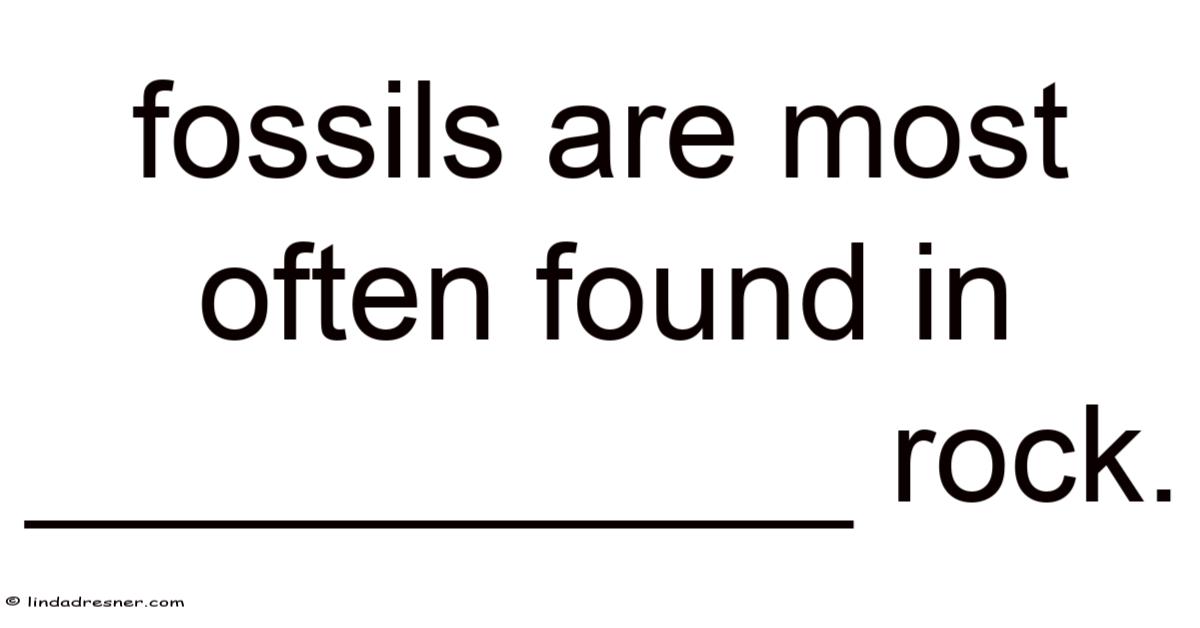
Understanding the secrets hidden within the Earth's layers requires a deep dive into the fascinating world of fossils. These remnants of ancient life offer a window into the past, allowing us to trace the evolution of species and the history of our planet. One of the most common questions that arise when exploring this topic is: where are fossils most often found? The answer lies in the type of rock that preserves these ancient treasures Small thing, real impact..
Fossils are most frequently discovered in sedimentary rocks. This is because sedimentary rocks form through the accumulation of layers of sediment over time. The process of fossilization often begins when an organism dies and is quickly buried by sediment, protecting it from decay. That said, these layers can be rich in organic material, which eventually gets compressed and cemented into rock. Over millions of years, the pressure and heat transform this organic matter into a fossil.
Sedimentary rocks are particularly valuable because they often contain well-preserved fossils. As an example, limestone, a type of sedimentary rock, is known for its ability to preserve nuanced details of ancient marine life. This leads to this is why many famous fossil sites are found in sedimentary layers. Even so, it helps to note that not all fossils are found in sedimentary rocks. Some may be preserved in volcanic ash or even within the mineral structures of igneous rocks, but these are less common.
The importance of sedimentary rocks in fossil discovery cannot be overstated. When studying these rocks, scientists can reconstruct ancient environments, understand the climate of the past, and even trace the evolution of species. But they act as natural time capsules, capturing snapshots of life from different eras. This makes sedimentary rocks the primary choice for fossil hunters and researchers alike Still holds up..
To further explore this topic, let's break down the key factors that determine where fossils are found. First, the environment in which an organism lived matters a lot. On the flip side, for instance, fossils of aquatic creatures are often discovered in marine sedimentary rocks, while those of land animals might be found in terrestrial sedimentary layers. This connection between environment and rock type helps scientists pinpoint the conditions under which fossils formed Took long enough..
Honestly, this part trips people up more than it should.
Another critical aspect is the age of the rock. Now, fossils in younger sedimentary layers tend to be more common because they have been deposited more recently. Over time, older rocks may erode or be buried, making them less accessible. This explains why many of the most well-preserved fossils are found in relatively recent sedimentary formations Simple, but easy to overlook..
Understanding the role of sedimentary rocks also highlights the challenges of fossil preservation. Now, not all organisms are equally likely to become fossils. Factors like the speed of burial, the presence of minerals, and the chemical composition of the sediment all influence whether a fossil survives the passage of time. This is why some areas, such as the Devonian Period, are rich in fossils due to the abundance of sedimentary layers from that era Took long enough..
For students and learners, this knowledge is essential. Still, it underscores the significance of studying sedimentary geology to uncover the stories embedded in the Earth. By recognizing the importance of these rocks, we gain a deeper appreciation for the processes that shape our planet and the history it holds Simple as that..
To wrap this up, the search for fossils is a journey through time, guided by the natural processes that create sedimentary layers. These rocks are not just formations; they are storytellers, whispering tales of ancient worlds. Whether you're a student, a researcher, or simply a curious mind, understanding the role of sedimentary rocks in fossil discovery enriches your connection to the natural world Still holds up..
The study of fossils in sedimentary rocks is a testament to the resilience of life and the power of geological time. As we continue to explore these layers, we uncover not only the past but also lessons that can guide our future. Let this article serve as a foundation for your exploration, inspiring you to delve deeper into the wonders of Earth's history Nothing fancy..
People argue about this. Here's where I land on it.
The detailed interplay between geological formations and fossil preservation continues to captivate scientists and enthusiasts alike. Worth adding: by examining the specific characteristics of sedimentary rocks, researchers can more accurately reconstruct the environments where ancient life thrived. Each layer of sediment carries a snapshot of a bygone era, offering clues about climate, geography, and even the evolutionary paths of species.
This process of discovery is not only about uncovering bones and shells but also about understanding the broader narrative of Earth's history. As scientists analyze these formations, they piece together a vivid picture of how life adapted and changed over time. The layers of sediment act as time capsules, preserving a record that spans millions of years. This ongoing exploration reinforces the importance of sedimentary studies in both academic and practical contexts.
Beyond that, the methods used to identify fossils within these rocks are constantly evolving. Think about it: technological advancements, such as imaging techniques and chemical analysis, enhance our ability to detect even the most delicate remnants of ancient organisms. These innovations not only improve accuracy but also open new windows into the mysteries of biodiversity and extinction events Not complicated — just consistent..
In essence, the connection between sedimentary rocks and fossil discovery underscores the dynamic nature of Earth's landscapes and the resilience of life. By embracing this relationship, we gain a richer understanding of our planet's past and the lessons it holds for the future.
So, to summarize, the journey through sedimentary layers remains a vital path for those interested in the history of life. These rocks serve as both archives and guides, urging us to appreciate the complexity of natural processes that have shaped our world. As we continue to study them, every discovery adds another chapter to the ever-unfolding story of existence But it adds up..
Unveiling Hidden Histories: Cutting‑Edge Tools in Sedimentary Paleontology
While classic fieldwork—hand‑picking specimens, measuring stratigraphic sections, and noting lithologic changes—remains the backbone of fossil hunting, the 21st‑century toolkit has expanded dramatically. Below are the most transformative techniques currently reshaping how we interrogate sedimentary archives.
| Technique | How It Works | What It Reveals |
|---|---|---|
| X‑ray Micro‑Computed Tomography (µCT) | A series of X‑ray images are taken from multiple angles and reconstructed into a 3‑D model. Day to day, , arthropod exoskeletons, plant seeds) without destroying the matrix. Here's the thing — g. | |
| Stable Isotope Geochemistry | Ratios of isotopes such as ^13C/^12C, ^18O/^16O, and ^87Sr/^86Sr are measured in carbonate or phosphate phases. , keratin, chitin) that are invisible under a light microscope. | |
| Laser‑Induced Breakdown Spectroscopy (LIBS) | A high‑energy laser pulse vaporizes a tiny spot of the rock; the emitted light is spectrally analyzed. | Preservation of soft‑tissue biomarkers (e.g. |
| Machine‑Learning Assisted Facies Classification | Algorithms trained on labeled datasets recognize patterns in grain size, mineralogy, and fossil content. Still, | Paleo‑temperature, water chemistry, and even trophic level information for extinct organisms. |
| Synchrotron Radiation Fourier‑Transform Infrared (SR‑FTIR) Spectroscopy | Intense synchrotron light probes molecular vibrations in fossil organic matter. | Internal morphology of delicate fossils (e.Practically speaking, |
These methods are not isolated silos; they often work in concert. To give you an idea, a µCT scan may first reveal a hidden trilobite within shale, after which LIBS can assess the surrounding matrix for trace metals that might have facilitated exceptional preservation. The resulting multi‑modal dataset provides a richer, more nuanced story than any single technique could deliver Simple as that..
From Local Outcrops to Global Correlations
Sedimentary rocks are inherently local—each basin records the story of its own tectonic setting, climate, and biological community. Yet, through careful correlation, these local narratives can be stitched together into a planetary tapestry Still holds up..
- Biostratigraphy – Index fossils such as Conodonts or Ammonites have narrow temporal ranges. By spotting the same species in geographically distant sections, geologists can synchronize disparate sedimentary sequences.
- Chemostratigraphy – Global shifts in carbon or sulfur isotopes, often tied to mass‑extinction events, appear as sharp excursions in the rock record worldwide. Detecting the same isotopic spike in a Permian basin in Texas and a coeval section in South Africa provides a time‑anchor that transcends lithology.
- Magnetostratigraphy – The Earth’s magnetic field flips polarity at irregular intervals. Remanent magnetization locked in fine‑grained sediments offers a “magnetic barcode” that can be matched across continents.
When combined, these correlation tools enable researchers to reconstruct not only where ancient organisms lived, but also how ecosystems responded to planetary-scale perturbations—such as volcanic winters, oceanic anoxia, or asteroid impacts Practical, not theoretical..
The Human Dimension: Citizen Science and Ethical Stewardship
Modern paleontology is increasingly collaborative. This leads to platforms like iDigBio and PaleoPortal invite amateur fossil hunters to upload photographs, GPS coordinates, and field notes. When vetted by professional curators, these contributions expand the spatial coverage of fossil data far beyond what any single research team could achieve.
Basically the bit that actually matters in practice.
Still, this democratization comes with responsibilities:
- Legal Awareness – Fossil collecting is regulated differently across jurisdictions. In many U.S. states, fossils from public lands are property of the government, while private landowners retain full rights. Internationally, the Convention on International Trade in Endangered Species (CITES) and UNESCO’s 1970 Convention govern the export of scientifically significant specimens.
- Conservation Ethics – Over‑collecting can damage fragile exposures and deplete sites for future study. Best practice dictates minimal extraction, thorough documentation, and, whenever possible, leaving specimens in situ for public education.
- Data Sharing – Open‑access databases accelerate discovery but must protect sensitive locality information to prevent looting.
By fostering a culture of responsible stewardship, the paleontological community ensures that the sedimentary archives remain available for generations to come Still holds up..
Looking Ahead: What the Next Decade May Hold
The convergence of geoscience, biology, and data science hints at several exciting frontiers:
- Ancient DNA & Proteomics – While DNA degrades rapidly, recent successes in retrieving protein fragments from Cretaceous dinosaur bone suggest that molecular paleontology could push further back than previously imagined.
- Virtual Field Trips – High‑resolution photogrammetry and lidar scanning now allow entire outcrops to be explored in a virtual environment, democratizing access to remote or fragile sites.
- Predictive Modeling – Coupling climate models with sediment transport simulations may enable scientists to forecast where undiscovered fossiliferous horizons are most likely to occur, optimizing field campaigns.
These advances will not replace the thrill of standing on a cliffside, feeling the grit of ancient sand underfoot, and spotting a glint of fossilized bone. Rather, they will augment our ability to interpret those moments with greater precision and context.
Conclusion
Sedimentary rocks are more than inert layers of earth; they are dynamic storytellers that preserve the whispers of life that once flourished on our planet. By mastering the principles of lithology, employing ever‑more sophisticated analytical tools, and embracing collaborative, ethical research practices, we reach chapters of Earth’s biography that inform everything from evolutionary theory to climate resilience.
Each new fossil unearthed adds a brushstroke to the grand mural of existence, reminding us that the past is not a distant, static tableau but a living archive that continues to shape our present and guide our future. As we turn the pages of stone, may we do so with curiosity, humility, and a steadfast commitment to preserving these irreplaceable windows into deep time No workaround needed..
