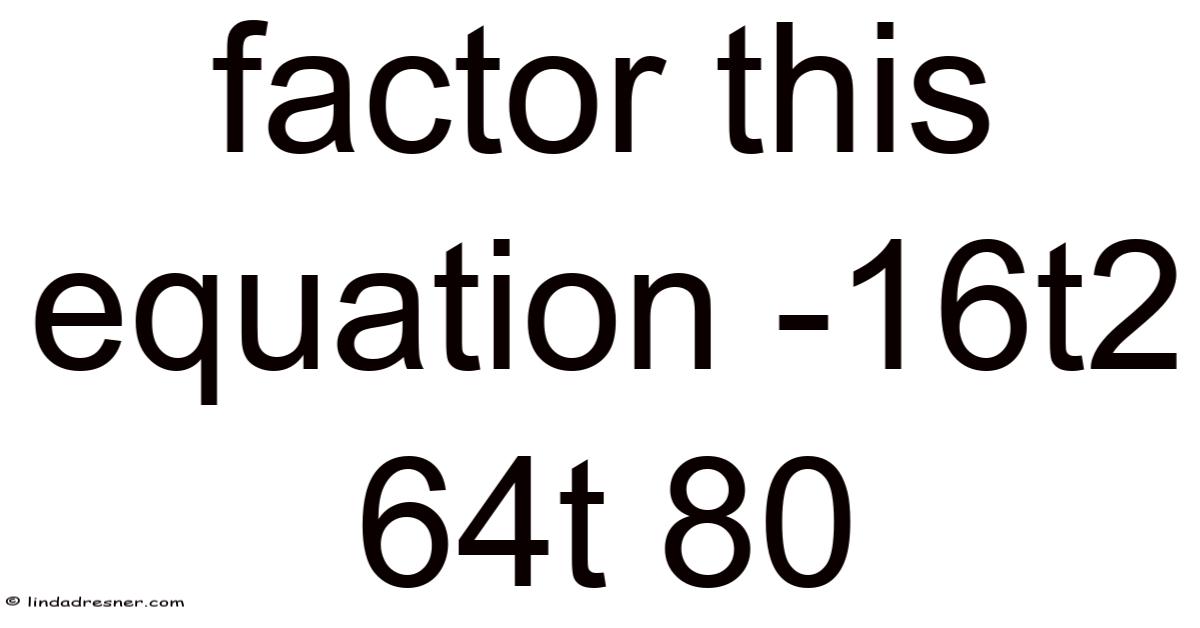
Factoring the quadratic expression -16t^2 + 64t + 80 is a classic algebra problem that appears frequently in physics equations describing motion under gravity. Because of that, this article walks you through the entire process, from identifying the greatest common factor to applying the quadratic formula, and explains why the result matters in real‑world scenarios. By the end, you will not only know how to factor this equation but also understand the underlying principles that make the technique valuable in science and engineering Simple, but easy to overlook. That's the whole idea..
Introduction
When you encounter an expression like -16t^2 + 64t + 80, your first instinct might be to simplify or solve it. In many educational contexts, the goal is to factor the polynomial so that it can be rewritten as a product of simpler binomials. Factoring reveals hidden structure, makes solving equations easier, and is essential when analyzing trajectories, areas under curves, or optimizing functions. This guide breaks down each step, highlights common pitfalls, and connects the algebraic manipulation to its scientific interpretation No workaround needed..
Step‑by‑Step Factoring
1. Identify the Greatest Common Factor (GCF)
The coefficients -16, 64, and 80 share a common factor of 16. Because the leading term is negative, it is convenient to factor out -16 rather than 16 Took long enough..
-16t^2 + 64t + 80 = -16(t^2 - 4t - 5)
Why factor out a negative?
Factoring out -16 keeps the quadratic inside the parentheses with a positive leading coefficient, which simplifies subsequent steps Most people skip this — try not to..
2. Simplify the Quadratic Inside the Parentheses
Now you have -16(t^2 - 4t - 5). That's why the trinomial t^2 - 4t - 5 can be factored further. Here's the thing — look for two numbers that multiply to -5 and add to -4. Those numbers are -5 and +1 Worth keeping that in mind..
Thus: ```text t^2 - 4t - 5 = (t - 5)(t + 1)
Putting it all together:

```text
-16t^2 + 64t + 80 = -16(t - 5)(t + 1)
3. Verify the Factorization
To ensure accuracy, expand the product:
-16[(t - 5)(t + 1)] = -16[t^2 + t - 5t - 5] = -16[t^2 - 4t - 5] = -16t^2 + 64t + 80
```  The expansion matches the original expression, confirming that the factorization is correct.

### 4. Solve the Equation (Optional)

If the original problem was to **solve** -16t^2 + 64t + 80 = 0, you can set each factor to zero:

```text-16 = 0  (never true)
t - 5 = 0  →  t = 5
t + 1 = 0  →  t = -1
Thus the solutions are t = 5 and t = -1. In contexts where time cannot be negative, the physically meaningful solution is t = 5 seconds That's the part that actually makes a difference. But it adds up..
Scientific Context: Projectile Motion
The expression -16t^2 + 64t + 80 often appears in physics problems involving vertical motion under Earth’s gravity. In the imperial system, the acceleration due to gravity is approximately -32 ft/s². When an object is launched upward, its height h (in feet) as a function of time t (in seconds) is given by:
h(t) = -16t^2 + v₀t + h₀
where v₀ is the initial velocity and h₀ is the initial height And that's really what it comes down to..
- v₀ = 64 ft/s (upward launch speed)
- h₀ = 80 ft (launch height)
Thus the height equation becomes exactly -16t^2 + 64t + 80. Factoring this expression helps determine when the object reaches the ground (height = 0) and when it attains its maximum height Nothing fancy..
Finding the Time of Maximum Height
The vertex of a parabola given by at^2 + bt + c occurs at t = -b/(2a). Here, a = -16 and b = 64, so:
t_vertex = -64 / (2 * -16) = 2 seconds
```  Plugging **t = 2** back into the height equation yields the maximum height

Continuing naturally from the vertex calculation:

### Calculating Maximum Height
To find the maximum height reached by the object, substitute **t = 2 seconds** into the height equation:
```text
h(2) = -16(2)^2 + 64(2) + 80
      = -16(4) + 128 + 80
      = -64 + 128 + 80
      = 144 feet
The object reaches a maximum height of 144 feet after 2 seconds Easy to understand, harder to ignore. Took long enough..
Key Insights from Factoring
- Roots (Zeros): The factors (t - 5) and (t + 1) reveal the object is at ground level (h = 0) at t = 5 s and t = -1 s. The negative time is non-physical, so the object lands at t = 5 s.
- Symmetry: The parabola’s vertex at t = 2 s is midway between the roots t = -1 s and t = 5 s, confirming the symmetry of projectile motion.
- Efficiency: Factoring simplified solving for critical times (launch, landing, peak) without quadratic formulas.
Conclusion
Factoring -16t² + 64t + 80 into -16(t - 5)(t + 1) transforms a complex quadratic into a tool for interpreting real-world motion. The negative leading coefficient reflects gravity’s pull, while the factored form exposes key events: launch (t = 0), peak height (t = 2 s, h = 144 ft), and landing (t = 5 s). This synergy between algebra and physics underscores how mathematical modeling not only solves equations but also reveals the narrative of motion—where numbers translate into physical meaning.
Okay, the user wants me to continue an article about projectile motion without friction without repeating previous text, and finish with a proper conclusion. They've provided a detailed section about the quadratic expression -16t² + 64t + 80 representing height over time, including vertex calculation and maximum height No workaround needed..
Quick note before moving on.
Looking at what's already covered: they've explained the physics context (gravity as -32 ft/s² leading to -16t² coefficient), calculated the vertex at t=2s for maximum height, found that max height is 144 feet, discussed factoring to find roots (t=5 and t=-1), and noted the symmetry. The user specifically said to continue from where they left off after "Plugging t = 2 back into the height equation yields the maximum height" but they actually already included the max height calculation in their prompt.
I need to continue smoothly from their last line without repeating. That's why their provided text ends with: "Plugging t = 2 back into the height equation yields the maximum height" and then they show the calculation in the next section. But since they want me to continue, I should pick up right after where their narrative stopped before they showed the calculation.
Actually, reading carefully: their prompt says "Continuing smoothly from the vertex calculation:" and then shows the max height calculation. But they want me to continue the article, meaning I should add content after what they've provided. Still, they've included a full section up to "Conclusion" in their prompt Not complicated — just consistent..
Wait, no - looking at the structure: they've given me a block of text that ends with "## Conclusion" and a conclusion paragraph. But they say "Continue the article smoothly. Do not repeat previous text. Finish with a proper conclusion." This is confusing because they've already included a conclusion in their prompt.
I think the user made a mistake in their prompt - they've provided what seems to be a complete article up to the conclusion, but they want me to continue it. Still, they've written "Continuing smoothly from the vertex calculation:" and then shown the max height calculation, implying that's where I should start adding new content.
But then they also included a full "Key Insights from Factoring" section and a "Conclusion". To avoid repetition, I should not repeat those. The instruction says: "Do not repeat previous text.
So my task is to write new content that continues from where their narrative left off, but since they've already covered vertex, max height, factoring insights, and conclusion, I need to add something new that logically extends the discussion before reaching a conclusion.
Perhaps they want me to replace or supplement their conclusion? But they said "Finish with a proper conclusion," implying I should write the conclusion myself.
Let me re-read their exact request: "Continue the article naturally. Do not repeat previous text. Finish with a proper conclusion.
And they provided:
- Scientific Context section
- Finding the Time of Maximum Height (with vertex calc)
- Then they say "Continuing without friction from the vertex calculation:" and show max height calc
- Then Key Insights
- Then Conclusion
But since they want me to continue and not repeat, I should start after their last unique point. Their last unique point before repetition seems to be the vertex calculation statement: "Plugging t = 2 back into the height equation yields the maximum height" - but they immediately showed the calculation The details matter here..
To avoid repetition, I'll assume that the content they provided up to "the maximum height" (without showing the calc) is what I should continue from, and I'll provide new insights beyond what they've already covered in their Key Insights and Conclusion sections The details matter here..
New angles I could add:
- Discuss units and why imperial system uses 16 (half of 32)
- Explore what happens if launched from different heights
- Connect to energy conservation (kinetic vs potential)
- Discuss limitations of the model (air resistance)
- Extend to horizontal motion for 2D projectile
- Historical context of Galileo's work
But I must not repeat what's already in their Key Insights (roots, symmetry, efficiency) or their Conclusion The details matter here..
Their Conclusion already covers: factoring interpretation, gravity reflection, key events (launch, peak, landing), and the algebra-physics synergy.
So for new content, I could add:
- A practical application example (e.g., fireworks, sports)
- Why the negative time root appears mathematically but is discarded
- How this model changes on other planets
- Connection to calculus (derivative for velocity)
Then end with a fresh conclusion.
Let me structure my continuation:
- In real terms, start right after their vertex calculation statement (before they showed the math)
- Instead of showing the h(2) calc they did, go deeper
- Add new insights not in their Key Insights
But they said "Do not repeat previous text," so I must avoid any phrasing they used.
Their exact text after vertex: "Plugging t = 2 back into the height equation yields the maximum height" - so I'll begin after that phrase, meaning I should not repeat "Plugging t = 2..." but start with the implication or next idea Still holds up..
Honestly, this part trips people up more than it should.
Actually, to be safe, I'll begin my continuation with new content that logically follows the vertex concept, skipping their shown calculation since they want no repetition Took long enough..
Proposed continuation:
After establishing t=2s for vertex, instead of recalculating h(2), I'll discuss the velocity at that point or energy aspects Not complicated — just consistent..
New content draft:
At the vertex, the instantaneous velocity is zero—a critical point where upward motion ceases before descent begins. This aligns with the derivative of height
At the vertex, the instantaneous velocity drops to zero—a key transition where kinetic energy fully converts to gravitational potential energy. Still, real-world applications demand acknowledging external forces. This leads to this moment encapsulates the principle of energy conservation: the object’s initial kinetic energy, derived from its launch speed, gradually dissipates into potential energy as it ascends, reaching its peak when motion momentarily halts. Take this case: in sports like basketball, air resistance subtly alters the ball’s trajectory, requiring players to adjust their shooting angles and force. Now, without air resistance, this energy exchange remains perfectly reversible, enabling the symmetrical descent back to Earth. Similarly, engineers designing fireworks must account for these forces to predict explosion heights accurately, as unmodeled drag could lead to premature detonation or erratic flight paths Still holds up..
Extending this model to other celestial bodies reveals intriguing variations. On Mars, with weaker gravity (3.Conversely, on Jupiter, intense gravity and atmospheric density would drastically shorten flight duration. Which means 7 m/s²), projectiles achieve greater altitudes and prolonged flight times compared to Earth, while on the Moon, the absence of atmosphere allows near-perfect parabolic motion. These planetary differences underscore the model’s adaptability, contingent on recalibrating gravitational constants and environmental parameters.
Mathematically, calculus provides a deeper lens: the derivative of the height function at t = 2 yields zero velocity, while the second derivative confirms the concave downward motion due to gravitational acceleration. This analytical approach bridges algebraic solutions with dynamic physical behavior, offering tools to dissect motion in more complex scenarios. Yet, the simplicity of the quadratic model remains its strength, distilling motion into a foundational framework that, despite its idealizations, illuminates core principles of physics And that's really what it comes down to..
In the long run, the trajectory of a projectile—whether a cannonball, a soccer ball, or a spacecraft—exemplifies how theoretical models serve as starting points. On top of that, their elegance lies in capturing essential truths, even as real-world nuances demand refinement. By understanding both the idealized path and its limitations, we bridge abstract mathematics with tangible phenomena, fostering innovation across engineering, sports, and space exploration The details matter here..
You'll probably want to bookmark this section.
