A Nosotros ______ Gusta La Escuela.

lindadresner
Mar 15, 2026 · 6 min read
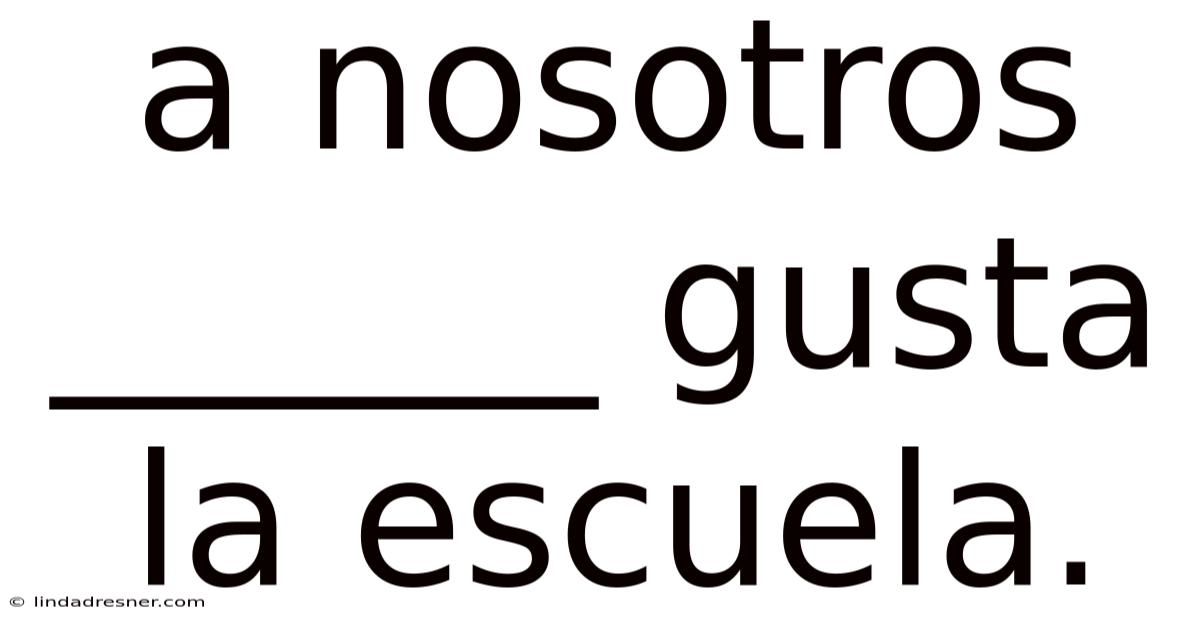
Table of Contents
Understanding "A Nosotros ______ Gusta La Escuela": A Complete Guide to Spanish Grammar
The Spanish phrase "a nosotros ______ gusta la escuela" represents a fundamental grammatical structure that many learners find challenging yet essential to master. This construction allows Spanish speakers to express their feelings or opinions about school in a nuanced and culturally appropriate manner. Understanding how to properly complete this blank with various elements can significantly enhance your ability to communicate naturally in Spanish, particularly when discussing preferences, likes, and dislikes.
The Grammar Structure Explained
At its core, "a nosotros ______ gusta la escuela" follows a specific pattern that differs from English sentence construction. The phrase begins with "a nosotros," which is the prepositional form of the pronoun "we" in Spanish. This prepositional form is used when the indirect object of the sentence is emphasized or clarified. In this case, "a nosotros" specifies that "we" are the ones who find school pleasing.
The verb "gusta" comes from the verb "gustar," which means "to please" or "to be pleasing to." This verb works differently than its English counterpart "to like." Instead of the subject performing the action of liking something, the subject is what is being liked or pleasing. Therefore, when we say "nos gusta la escuela," we're literally saying "school is pleasing to us," which translates to "we like school" in English.
The blank in our phrase can be filled with various elements that modify the meaning of the sentence, allowing speakers to express different degrees or types of appreciation for school.
What Can Fill the Blank?
Several types of words and expressions can appropriately fill the blank in "a nosotros ______ gusta la escuela." Each option changes the nuance of the sentence while maintaining the grammatical correctness of the structure.
Direct Object Pronouns
The most common fillers are direct object pronouns, which replace nouns to avoid repetition. These pronouns must agree in number with the noun they replace:
- Me: "A me gusta la escuela" (incorrect - must use "a mí")
- Te: "A te gusta la escuela" (incorrect - must use "a ti")
- Le: "A le gusta la escuela" (incorrect - must use "a él/ella/usted")
- Nos: "A nos gusta la escuela" (correct)
- Os: "A os gusta la escuela" (correct - used in Spain)
- Les: "A les gusta la escuela" (incorrect - must use "a ellos/ellas/ustedes")
When using pronouns, it's important to note that the prepositional forms (mí, ti, él, etc.) are used instead of the direct object pronouns (me, te, le, etc.).
Quantifiers and Adjectives
You can also use quantifiers and adjectives to specify how much you like school or what kind of feeling you have toward it:
- Mucho: "A nosotros mucho gusta la escuela" (We like school a lot)
- Poco: "A nosotros poco gusta la escuela" (We don't like school much)
- Realmente: "A nosotros realmente gusta la escuela" (We really like school)
- Siempre: "A nosotros siempre gusta la escuela" (We always like school)
- También: "A nosotros también gusta la escuela" (We also like school)
Negative Expressions
To express dislike or indifference toward school, you can use negative expressions:
- No: "A nosotros no gusta la escuela" (We don't like school)
- Nada: "A nosotros nada gusta la escuela" (We don't like school at all)
- Tampoco: "A nosotros tampoco gusta la escuela" (We don't like school either)
Cultural Context: Attitudes Toward School in Spanish-Speaking Countries
Understanding how this phrase is used in different Spanish-speaking cultures adds depth to your language learning experience. Attitudes toward education vary significantly across the Spanish-speaking world, influenced by historical, economic, and social factors.
In many Spanish-speaking countries, education is highly valued as a means of social mobility. Phrases like "a nosotros mucho gusta la escuela" might be more common in households where academic achievement is emphasized. However, this enthusiasm isn't universal. In some regions, particularly where educational resources are limited or where economic pressures force children to work rather than attend school, the sentiment might be better expressed as "a nosotros poco gusta la escuela" or even "a nosotros no gusta la escuela."
In countries like Spain, Argentina, and Chile, where education is more accessible and standardized, you might hear more positive expressions about school. Meanwhile, in some Latin American countries with significant indigenous populations, traditional educational systems might coexist with formal schooling, creating complex attitudes that could be expressed through nuanced variations of our basic phrase.
Common Mistakes and How to Avoid Them
English speakers often struggle with the "gustar" construction because it works differently than the English "to like." Here are some common mistakes to avoid:
-
Omitting the preposition "a": Never say "nos gusta la escuela" without "a" when emphasizing the indirect object. The correct form is "a nos gusta la escuela" or simply "nos gusta la escuela" without emphasis.
-
Using incorrect pronoun forms: Remember to use "a mí, a ti, a él, etc." instead of "me, te, le" when emphasizing the indirect object.
-
Subject-verb agreement confusion: The verb agrees with the thing being liked, not the person doing the liking. Since "escuela" is feminine and singular, we use "gusta" not "gustan."
-
Word order issues: While Spanish is more flexible with word order than English, the basic structure "a nosotros [blank] gusta la escuela" should be maintained for clarity.
Practice Exercises to Master This Structure
To become comfortable with this grammatical construction
Practice Exercises to Master This Structure
To become comfortable with this grammatical construction, try these exercises:
-
Fill in the Blanks: Complete the sentences using the correct form of "gustar" and the appropriate indirect object pronoun/emphasis.
- A mí ______ (gustar) los deportes.
- A vosotros ______ (gustar) el arte.
- A ella ______ (gustar) la historia, pero a nosotros ______ (gustar) la ciencia.
- A los profesores ______ (gustar) los estudiantes curiosos.
- ¿A ti ______ (gustar) los exámenes? ______ (gustar) mucho.
-
Translate to Spanish: Render these sentences using the "a [person] + gusta/gustan + thing" structure.
- We like mathematics.
- They (formal) like the library.
- I don't like homework.
- Do you (plural, informal) like the cafeteria?
- She likes literature, and he likes music too.
-
Respond Situationally: Imagine you're talking with different people about school. Respond naturally using the structure.
- Friend 1: "¡A mí me encanta la biología!" (I love biology!) -> You: "¡A mí ______! Prefiero ______."
- Friend 2: "¿A ti te gustan los exámenes?" (Do you like exams?) -> You: "No, a mí ______. ______."
- Teacher: "A los alumnos les gusta este nuevo proyecto?" (Do the students like this new project?) -> You (as a student): "Sí, a nosotros ______. ______."
-
Creative Expression: Write 3-4 sentences describing your own feelings about school (or a specific subject/activity within school) using the "a + pronoun" structure. Try to include both positive and negative sentiments.
Conclusion
Mastering the phrase "a nosotros gusta la escuela" and its variations unlocks a fundamental building block of Spanish grammar: the "gustar" construction. While seemingly simple, its structure – where the thing being liked acts as the grammatical subject and the person doing the liking is the indirect object – requires focused practice to use naturally. By understanding the cultural nuances reflected in attitudes towards education across the Spanish-speaking world and diligently avoiding common pitfalls like incorrect pronoun usage or preposition omission, learners can move beyond rote memorization. The exercises provided offer practical pathways to internalize this structure, enabling learners to articulate personal preferences with grammatical precision and cultural sensitivity. Ultimately, grappling with this phrase not only enhances grammatical accuracy but also provides a window into the diverse values and experiences shaping educational landscapes across the globe, enriching the language learning journey far beyond the classroom walls.
Latest Posts
Latest Posts
-
A Bag Mask Device Is Used To Provide
Mar 15, 2026
-
Walmart Safety For Hourly Cbl Answers
Mar 15, 2026
-
Identification Of Selected Anions Lab Answers
Mar 15, 2026
-
In Order To Remain Certified I Have To
Mar 15, 2026
-
How Does Alcohol Use Affect Boat Operators Or Passengers
Mar 15, 2026
Related Post
Thank you for visiting our website which covers about A Nosotros ______ Gusta La Escuela. . We hope the information provided has been useful to you. Feel free to contact us if you have any questions or need further assistance. See you next time and don't miss to bookmark.
