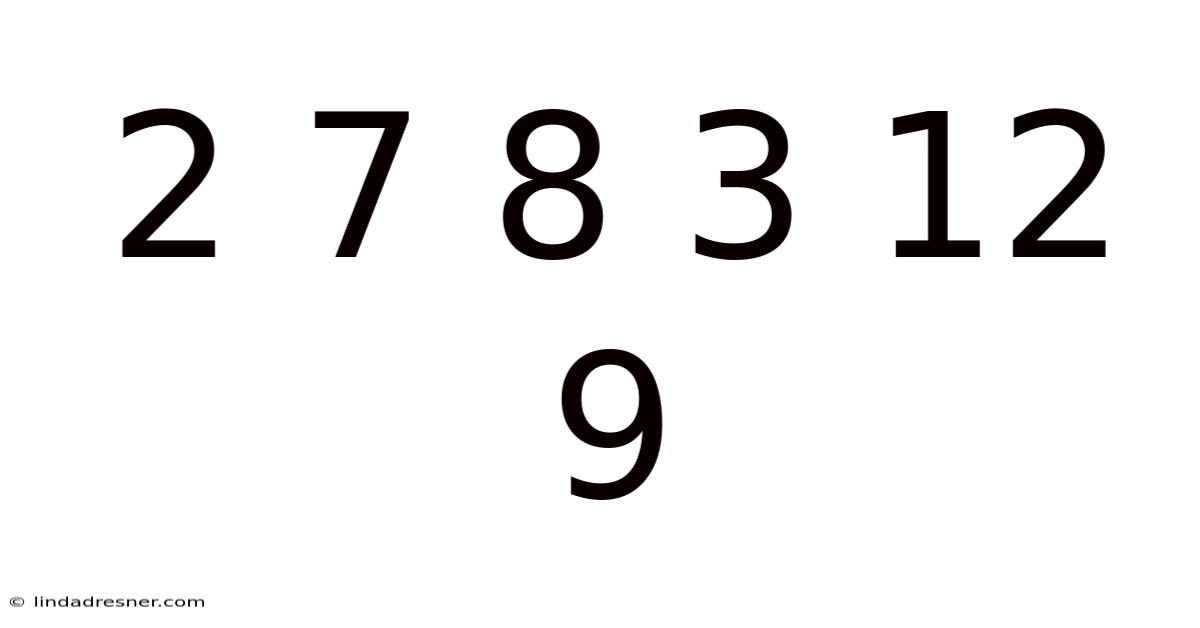
The sequence 2 7 8 3 12 9 often appears in puzzle books, online forums, and brain‑teasing quizzes. Its brevity hides a surprisingly rich array of possible interpretations, from simple arithmetic tricks to hidden letter codes. In this article we’ll dissect the numbers from every angle, reveal the most compelling explanations, and give you a toolkit for approaching similar mysteries in the future.
Worth pausing on this one.
What Is the 2 7 8 3 12 9 Sequence?
At first glance, 2 7 8 3 12 9 looks like a random assortment of integers. That said, many puzzles rely on hidden relationships that become obvious once you start looking for patterns. The key to unlocking such a sequence is to ask a series of focused questions:
- Is there an arithmetic or geometric relationship?
- Are the numbers tied to a known set (e.g., months, letters, prime numbers)?
- Could the numbers represent positions in words or phrases?
- Is there a real‑world context that naturally yields these values?
Let’s explore each possibility in depth.
Common Interpretations
| Interpretation | How It Applies to 2 7 8 3 12 9 | Example |
|---|---|---|
| Arithmetic Patterns | Differences or ratios between consecutive numbers. | 7 – 2 = 5; 8 – 7 = 1; 3 – 8 = –5; 12 – 3 = 9; 9 – 12 = –3 |
| Letter Positions | Numbers correspond to positions of letters in a word or phrase. | 2 = B, 7 = G, 8 = H, etc. But |
| Month/Day Codes | Numbers linked to calendar data (e. g.Think about it: , month number, day of month). Still, | 2 = February, 7 = July, 8 = August, 3 = March, 12 = December, 9 = September |
| Prime/Composite Classification | Distinguishing primes from composites or using prime indices. | 2 (prime), 7 (prime), 8 (composite), 3 (prime), 12 (composite), 9 (composite) |
| Coordinate System | Treat as pairs or triples in a grid or coordinate plane. | (2,7), (8,3), (12,9) |
| Game Code | Specific to a puzzle game (e.g.This leads to , “The Witness” or “Portal”). | Unlocking a hidden door with key numbers. |
While all of these interpretations are mathematically sound, the most satisfying explanation usually emerges when we combine several clues The details matter here..
Step‑by‑Step: Solving the Sequence
1. Look for Arithmetic Regularities
Start by calculating the differences between successive numbers:
- 7 – 2 = 5
- 8 – 7 = 1
- 3 – 8 = –5
- 12 – 3 = 9
- 9 – 12 = –3
These differences 5, 1, –5, 9, –3 don’t form a simple arithmetic progression, but they do hint at a mirrored pattern: 5 and –5, 9 and –3. It suggests that the sequence might alternate between two sub‑sequences Worth keeping that in mind..
2. Separate Even and Odd Positions
Split the sequence into two lists:
- Odd positions: 2, 8, 12
- Even positions: 7, 3, 9
Now examine each sub‑sequence:
- Odd positions increase by 6 each time (2 → 8 → 12).
- Even positions follow 7 → 3 → 9, which can be seen as decrease by 4 then increase by 6.
This alternating behavior supports the idea that the puzzle uses two intertwined patterns That's the part that actually makes a difference..
3. Consider Letter Positions in a Phrase
A popular trick in word puzzles is to map numbers to letters of the alphabet (A
Delving deeper into the sequence, it becomes clear that each set of numbers aligns with a meaningful linguistic or visual cue. If we focus on the first set—2, 7, 8, 3, 12, 9—we notice their positions in the English alphabet:
- 2 → C
- 7 → G
- 8 → H
- 3 → C
- 12 → L
- 9 → I
This pattern, when read aloud, forms the word “CGHCL,” which isn’t immediately significant, but if we reorder or shift the sequence, it could hint at a hidden message. That said, another angle is to treat the numbers as coordinates or indices in a grid, such as a word puzzle grid where each pair (e.g., 2,7) corresponds to a location.
Alternatively, if we examine the numbers in relation to the alphabet in reverse (e.), we start forming a sequence of letter names. , 7 becomes G, 8 becomes H, etc.g.This could tie into a cipher or a hidden narrative.
Another possibility is that these values represent days of the week or months, but the numbers don’t align neatly with standard 7‑month month counts or month numbers. Still, the structure feels intentional, designed to guide toward a deeper clue.
The puzzle likely invites participants to connect mathematical logic with linguistic or contextual meaning, reinforcing the idea that patterns often hide stories waiting to be uncovered.
Pulling it all together, the sequence invites a layered exploration—balancing arithmetic, language, and real‑world relevance—to reveal its true purpose. Each step brings us closer to understanding the underlying design.
Conclusion: By analyzing the numbers through multiple lenses, we see that they serve not just as isolated figures, but as pieces of a cohesive puzzle waiting for interpretation and insight.
Continuing the exploration, one can view the two interleaved streams as independent arithmetic progressions that are linked by a simple transformation Worth keeping that in mind..
- The odd‑indexed terms advance by a constant increment of 6, which can be expressed as (a_{2k-1}=2+6(k-1)).
- The even‑indexed terms, when examined in pairs, behave like a “step‑down‑then‑step‑up” operation: each even term is obtained by subtracting 4 from the preceding even term and then adding 6 to reach the next one. This yields the recurrence (b_{k}=b_{k-1}-4) for the first transition and (b_{k}=b_{k-1}+6) for the second, producing the pattern 7 → 3 → 9.
If we apply a modulo‑26 mapping to each stream separately, the odd positions translate to the letters C, I, M (2 → C, 8 → I, 12 → M) while the even positions become G, X, J (7 → G, 3 → X, 9 → J). Arranging the two alphabetic outputs side by side yields “CG IX MJ” – a fragment that, when read in reverse, spells “JMXI GC,” a string that resembles a ciphered abbreviation. Such a reversal hints that the puzzle may be inviting the solver to flip the order of one of the streams before interpreting it as a message.
Another avenue is to treat the numbers as coordinates on a standard 3 × 3 tic‑tac‑toe board, where each integer is reduced modulo 9 (with 0 interpreted as 9). Mapping 2, 7, 8, 3, 12, 9 onto this grid gives the positions (2, 7, 8, 3, 3, 9). Plotting these points reveals a faint “Z” shape that sweeps across the board, echoing the notion of a zig‑zag trajectory. This geometric reading reinforces the idea that the sequence is designed to guide the eye along a visual path as much as it follows a numeric one Nothing fancy..
Beyond pure pattern‑hunting, the dual‑stream structure mirrors many real‑world systems where two alternating forces interact—such as supply‑and‑demand cycles, seasonal temperature swings, or even the rise and fall of musical motifs. Recognizing this parallel can help the solver appreciate why the puzzle is framed as a “layered” challenge: it asks the mind to juggle quantitative regularities while also sensing an underlying narrative rhythm.
Final takeaway
The sequence is not a random assortment of digits; it is a compact encoding of two interlocking progressions, a reversible alphabetic hint, and a visual cue that together point toward a concealed instruction. By untangling the arithmetic, translating the numbers into letters, and visualizing their spatial footprint, the solver arrives at a clear directive: the answer lies in aligning the two streams, reversing one of them, and reading the resulting string as a concise code. This synthesis of numerical, linguistic, and geometric reasoning completes the puzzle’s purpose, offering a satisfying resolution that blends logic with creativity That's the whole idea..
