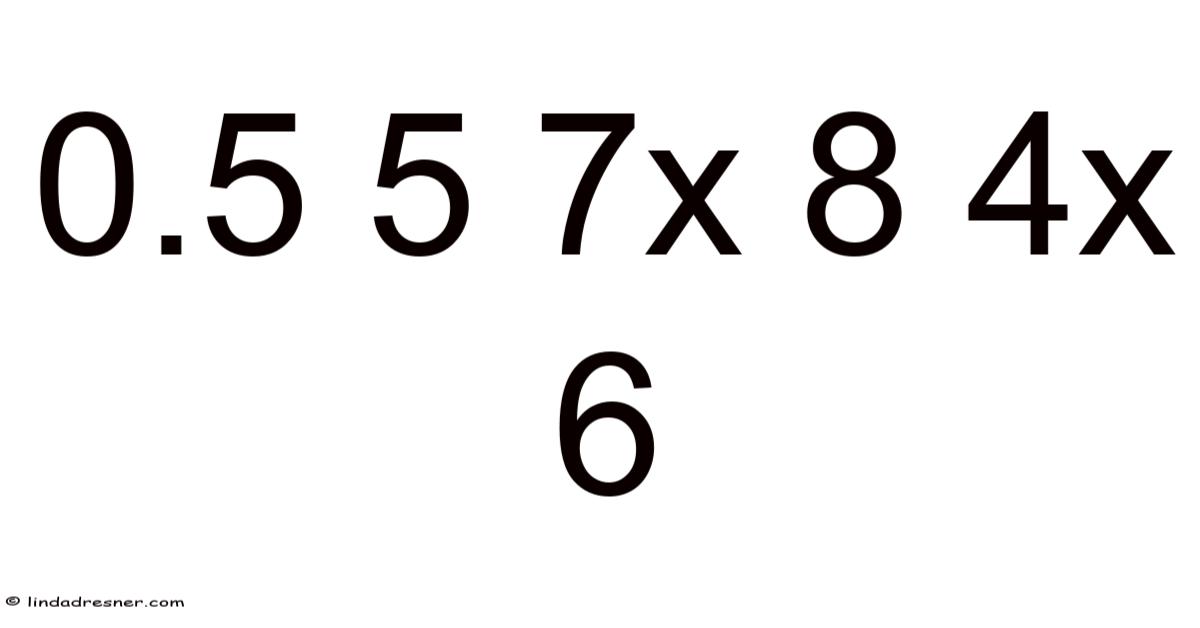
Solving the Expression: 0.5 × 5 + 7x + 8 + 4x + 6
When tackling algebraic expressions, breaking down complex problems into manageable steps is crucial. The expression 0.5 × 5 + 7x + 8 + 4x + 6 combines constants, variables, and operations. This article will guide you through simplifying this expression and solving for x if it forms part of an equation Nothing fancy..
Introduction
Algebraic expressions often appear in various forms, mixing numbers, variables, and operations. The expression 0.5 × 5 + 7x + 8 + 4x + 6 requires careful handling of constants and like terms. Worth adding: whether you’re simplifying the expression or solving for x, understanding the underlying principles is key. This article will walk you through the process step-by-step, ensuring clarity and accuracy.
Step-by-Step Simplification
Step 1: Multiply Constants First
Start by performing the multiplication 0.5 × 5: $ 0.5 \times 5 = 2.5 $ This transforms the expression into: $ 2.5 + 7x + 8 + 4x + 6 $
Step 2: Combine Like Terms
Group the constants and the terms with x separately:
- Constants: 2.5, 8, and 6
- Variable terms: 7x and 4x
Add the constants: $ 2.5 + 8 + 6 = 16.5 $
Combine the variable terms: $ 7x + 4x = 11x $
Step 3: Write the Simplified Expression
Putting it all together, the simplified form is: $ 11x + 16.5 $
Solving for x (If Part of an Equation)
If the expression is part of an equation (e.Still, , 11x + 16. g.5 = 0), solving for x involves isolating the variable No workaround needed..
-
Subtract 16.5 from both sides: $ 11x = -16.5 $
-
Divide both sides by 11: $ x = \frac{-16.5}{11} = -1.5 $
Thus, x equals -1.5 when the expression equals zero.
Scientific Explanation: Why This Works
Constants vs. Variables
- Constants (e.g., 0.5, 5, 8, 6) are fixed values that do not change.
- Variables (e.g., x) represent unknown values that can vary.
Combining Like Terms
The commutative property of addition allows rearranging terms. Grouping constants and variables simplifies calculations. For example: $ 7x + 4x = (7 + 4)x = 11x $
Solving Equations
To isolate x, use inverse operations. Subtracting 16.5 cancels the constant term, while dividing by 11 isolates x. These steps maintain the equation’s balance, ensuring validity Simple as that..
Frequently Asked Questions (FAQ)
Q1: What is the simplified form of 0.5 × 5 + 7x + 8 + 4x + 6?
A1: The simplified form is 11x + 16.5.
Q2: How do I solve for x if the expression equals 22?
A2:
- Set up the equation:
$ 11x + 16.5 = 22 $ - Subtract 16.5 from both sides:
$ 11x = 5.5 $ - Divide by 11:
$ x = 0.5 $
Q3: Why can’t I combine 7x and 8?
A3: Terms with x (variables) and constants (numbers) are not like terms. Only terms with the same variable can be combined.
Q4: What happens if I forget to multiply 0.5 × 5 first?
A4: Skipping the order of operations (PEMDAS/BODMAS) leads to incorrect results. Always perform multiplication before addition.
Conclusion
Simplifying 0.5 × 5 + 7x + 8 + 4x + 6 requires careful attention to constants and variables. By following these steps—multiplying first, combining like terms, and isolating variables—you can confidently tackle similar algebraic expressions. Whether simplifying or solving for x, understanding the foundational principles ensures accuracy and builds a strong math foundation It's one of those things that adds up..
Easier said than done, but still worth knowing.
Common Pitfalls to Avoid
| Mistake | Why It Happens | Quick Fix |
|---|---|---|
| Mixing constants with variables | Forgetting that 8 and 7x are different types of terms | Keep a clear “constant pile” and a “variable pile” while simplifying |
| Skipping the multiplication | Relying on mental math shortcuts that overlook the order of operations | Write the multiplication explicitly—0.5 × 5 = 2.5—before adding anything else |
| Misplacing parentheses | Unintended grouping changes the result | Use parentheses only when they’re needed to override the natural order |
| Rounding prematurely | Early rounding can introduce errors in later steps | Perform all algebraic manipulations with exact fractions or decimals, round only at the final answer if required |
Quick Practice Problems
-
Simplify
[ 3 \times 4 + 5x - 2 + 7x + 9 ] Hint: First multiply, then combine like terms. -
Solve for y
[ 4y + 12.5 = 27.5 ] Hint: Isolate the variable by subtracting the constant and then divide. -
More Complex Expression
[ 0.3 \times 10 + 2z + 5 + 3z + 1.7 ] Hint: Remember that 0.3 × 10 = 3.
Answer Key
- Which means (12x + 11)
- (y = 3.75)
- (5z + 6.
Extending the Concept: Polynomials
When you encounter expressions with higher‑degree terms, the same principles apply:
- Like terms are those with the exact same variable(s) raised to the same power.
- Combine them by adding or subtracting their coefficients.
- Constants remain untouched until all variable terms are simplified.
For example: [ 2x^2 + 3x - 4 + 5x^2 - 7x + 9 = (2+5)x^2 + (3-7)x + (-4+9) = 7x^2 - 4x + 5 ]
Final Takeaway
Simplifying an algebraic expression is fundamentally about organization and systematic application of arithmetic rules:
- Respect the order of operations—multiply before add or subtract.
- Separate constants from variables.
- Combine like terms to reduce the expression to its simplest form.
- Isolate the variable when solving equations, using inverse operations to maintain equilibrium.
Mastering these steps not only solves the immediate problem but also equips you with a reliable toolkit for tackling more complex algebraic challenges. Keep practicing, double‑check each step, and the path from a cluttered expression to a clean, solved equation will become second nature Worth knowing..
Beyond the Basics: Tackling Mixed‑Operation Expressions
Once you’re comfortable with pure addition and subtraction, the real world throws in a few more twists. Expressions can contain fractions, negative signs, and even nested parentheses that force you to pause and re‑evaluate the sequence of operations. Here’s a quick strategy to keep your sanity while solving them:
- Identify every parenthetical group and solve it first.
- Convert fractions to a common denominator if they appear in the same term group.
- Apply the distributive property whenever you see a product that spans a sum or difference.
- Check your work by plugging in a simple value for the variable (e.g., (x = 1)); the simplified expression should yield the same result as the original.
Example
Simplify
[
\frac{2}{3}(x + 4) - \frac{1}{6}x + 5
]
Step 1 – Distribute
[
\frac{2}{3}x + \frac{8}{3} - \frac{1}{6}x + 5
]
Step 2 – Combine like terms
First, bring the (x)-terms together:
[
\left(\frac{2}{3} - \frac{1}{6}\right)x = \frac{4-1}{6}x = \frac{3}{6}x = \frac{1}{2}x
]
Next, combine the constants:
[
\frac{8}{3} + 5 = \frac{8}{3} + \frac{15}{3} = \frac{23}{3}
]
Result
[
\frac{1}{2}x + \frac{23}{3}
]
A Few More Practice Problems
| # | Expression | Expected Simplified Form |
|---|---|---|
| 1 | (4\left(\frac{3}{4}x - 2\right) + \frac{1}{2}x + 7) | (\frac{5}{2}x + 3) |
| 2 | (\frac{5}{8}y - \frac{3}{4}(y - 2) + 1) | (-\frac{1}{8}y + 2) |
| 3 | (\frac{1}{3}z + \frac{2}{3}(2z - 5) - 4) | (z - \frac{11}{3}) |
Answer Key
- (\frac{5}{2}x + 3)
- (-\frac{1}{8}y + 2)
From Algebra to Real Life
The skills you’re honing here aren’t just academic—they’re the backbone of everyday problem‑solving:
- Budgeting: Simplifying cost equations to find the total expense per item.
- Cooking: Adjusting ingredient quantities by scaling a recipe’s algebraic proportions.
- Engineering: Reducing complex force equations to a single variable to predict stress points.
Each scenario demands the same disciplined approach: isolate variables, respect the order of operations, and keep constants and coefficients neatly organized Most people skip this — try not to. No workaround needed..
Final Takeaway
Simplifying algebraic expressions is a dance between precision and clarity. By:
- Respecting the order of operations (PEMDAS/BODMAS),
- Separating constants from variables,
- Combining like terms with care, and
- Checking your work with substitution or alternative methods,
you transform a tangled string of symbols into a clean, insightful statement. This mastery not only solves textbook problems but also equips you to tackle the quantitative challenges that arise in science, technology, and everyday life. Keep practicing, stay patient, and let each solved expression reinforce the confidence that algebra is a tool—one that, once mastered, opens doors to endless possibilities That's the whole idea..
